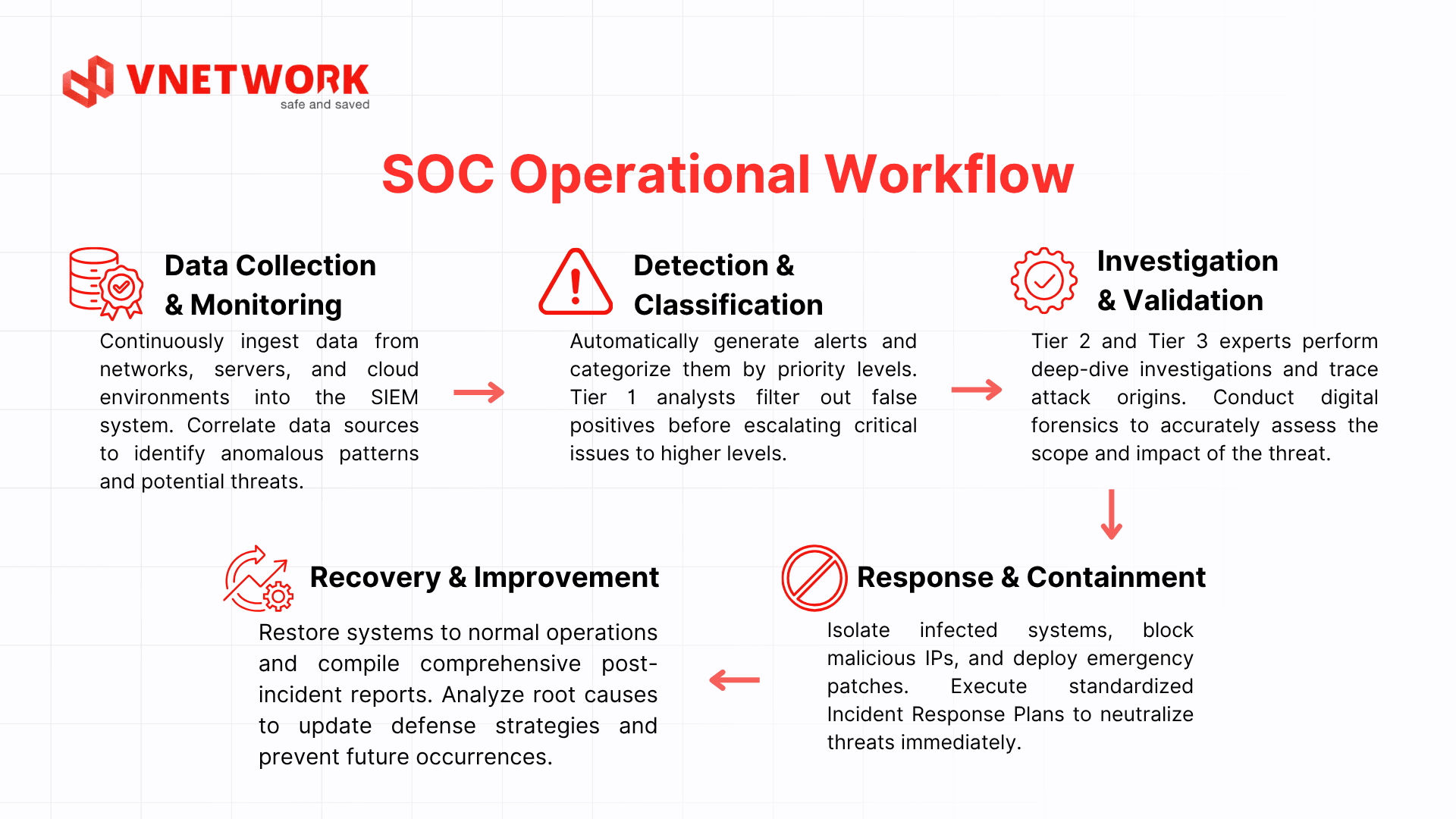
SOC (Security Operations Center), also known as a cybersecurity operations center, is a specialized unit responsible for monitoring, detecting, analyzing, and responding to cybersecurity incidents in real time. A SOC acts as a security command center, combining three essential elements: people, processes, and technology.
Security Operations Center analysts continuously monitor an organization's entire network infrastructure, servers, applications, and data around the clock. A SOC does not just respond after incidents occur; it proactively hunts for latent threats before they can cause real harm.
Security Operations Centers are deployed in various models, each suited to the scale and security needs of different organizations.
| Type | Description | Best suited for | Key advantage |
| In-house SOC | Build team, infrastructure, and processes using internal resources | Large organizations with high budgets and strict security requirements | Full control over all monitoring operations and data |
| Managed SOC (Outsourced) | Hire an MSSP to operate the full SOC on your behalf | SMBs lacking a dedicated security team | Lower upfront investment; fast access to expert skills |
| Hybrid SOC | Combine internal staff with specialized support from an MSSP | Large enterprises needing flexibility and resource optimization | Flexible balance between in-house control and external expertise |
| Virtual SOC | Remote team operating via cloud platforms, no fixed headquarters | Organizations with distributed infrastructure migrating to the cloud | Cloud-optimized, geographically unrestricted |
A SOC performs several critical functions within an organization's security ecosystem:
A Security Operations Center operates through a continuous, multi-stage process, from data collection all the way through response and post-incident improvement.
All data flows from the network infrastructure, servers, endpoints, applications, and cloud services are continuously ingested into a SIEM (Security Information and Event Management) system. The SIEM correlates data from multiple sources to identify anomalous patterns that may signal an attack. This is a foundational step in any comprehensive cloud security strategy.
When the system detects abnormal behavior, alerts are automatically generated and prioritized by severity. Tier 1 analysts perform an initial review to filter out false positives before escalating genuine threats to higher-level handling.
Tier 2 and Tier 3 analysts conduct in-depth investigations once an alert is confirmed as a real threat. The investigation includes digital forensics analysis, attack origin tracing, and impact assessment.
Once an incident is confirmed, the SOC team immediately executes containment measures: isolating infected systems, blocking malicious IP addresses, disabling compromised accounts, and deploying emergency patches. The response follows a pre-established Incident Response Plan.
After the incident is contained, the SOC collaborates with relevant teams to restore systems to normal operation. A post-incident report is prepared to analyze root causes and update defensive processes to prevent recurrence.
Deploying a Security Operations Center delivers measurable value, especially in a landscape where cyber threats are growing more complex.
A SOC significantly shortens the time from attack to detection and resolution. Continuous monitoring and standardized response procedures help organizations minimize damage from every security incident.
A Security Operations Center safeguards customer data, financial information, and intellectual property from theft or sabotage. This directly helps organizations avoid serious financial losses and legal risks associated with data breaches.
Through early detection and prevention, a SOC helps organizations avoid operational disruptions caused by cyberattacks. This is especially critical for organizations in finance, e-commerce, and technology services, where even an hour of downtime translates into significant revenue loss.
A SOC helps organizations meet compliance requirements from regulators and international standards. SOC logging and reporting systems provide clear audit evidence, giving organizations greater confidence during periodic security audits.
An organization with a professionally operated Security Operations Center sends a clear signal that security is a strategic priority. This strengthens confidence among customers, partners, and investors, particularly in high-security sectors such as banking, healthcare, and government.
When evaluating and selecting a Security Operations Center solution, organizations should carefully consider the following criteria:
Prioritize SOC providers with genuine 24/7 monitoring coverage backed by real experts, not purely automated systems. Mean Time to Respond (MTTR) and Mean Time to Detect (MTTD) are two critical metrics that providers should commit to explicitly within their Service Level Agreement (SLA).
The SOC solution must integrate seamlessly with the organization's current security infrastructure, including firewalls, intrusion detection systems, endpoint security solutions, and identity management tools. Poor integration creates blind spots in monitoring coverage.
The security analyst team is the decisive factor in SOC effectiveness. Organizations should assess the provider's certifications, professional qualifications, and real-world incident handling experience, particularly within their industry and at a comparable scale.
A SOC's technology foundation should include a modern SIEM, SOAR (Security Orchestration, Automation and Response) for automated response, and continuously updated Threat Intelligence feeds. Many organizations also integrate SOC capabilities with a Zero Trust architecture to strengthen access control. Evaluate the platform's scalability as infrastructure grows.
SOC providers should deliver clear periodic reports, intuitive monitoring dashboards, and full incident history traceability. Organizations must be able to understand what is happening across their systems, not only receive notifications when something goes wrong.
The cost of building an in-house SOC is typically substantial when factoring in personnel, technology, and operations. A Managed SOC gives organizations access to professional security capabilities at a predictable monthly or annual cost. Organizations should evaluate the Total Cost of Ownership (TCO) when comparing options.
VNETWORK does not offer SOC as a standalone service. Instead, Security Operations Center capabilities are embedded directly into two core security platforms: VNIS and EG-Platform. This approach means organizations benefit from comprehensive protection without needing to build or operate an independent security operations center.
VNIS (VNETWORK Internet Security) is a comprehensive Web/App/API security and acceleration platform that protects organizations against multi-layered threats in real time. VNIS operates in two layers: AI-powered Smart Load Balancing and Multi-CDN handle DDoS Layer 3/4 attacks before malicious traffic reaches the system, while an AI-integrated Cloud WAAP blocks DDoS Layer 7, malicious bots, and OWASP Top 10 vulnerabilities. VNIS security rules are updated continuously, enabling detection and prevention of newly emerging attack techniques before they can cause damage. VNIS is suited for e-commerce businesses, financial institutions, and any organization that needs to protect websites, applications, and APIs against large-scale, high-frequency attacks.
EG-Platform (Email Gateway Platform) is an AI and Machine Learning email security platform providing comprehensive bidirectional email protection for organizations. EG-Platform operates across three layers: Spam Guard filters and blocks spam, phishing, and malware-laden emails early using SPF/DKIM/DMARC authentication; Receive Guard inspects content and attachments in a sandbox environment to neutralize dangerous links before users can access them; and Send Guard controls outbound email to prevent internal accounts from being exploited to distribute phishing or leak sensitive data. EG-Platform meets the ITU-T X.1236 standard of the International Telecommunication Union, making it suitable for organizations with high information security compliance requirements.
Both VNIS and EG-Platform are operated under the direct oversight of VNETWORK's SOC team, which works continuously around the clock. The SOC team is responsible for monitoring all security events as they arise, triaging and investigating alerts, and executing standardized response procedures when genuine threats are identified.
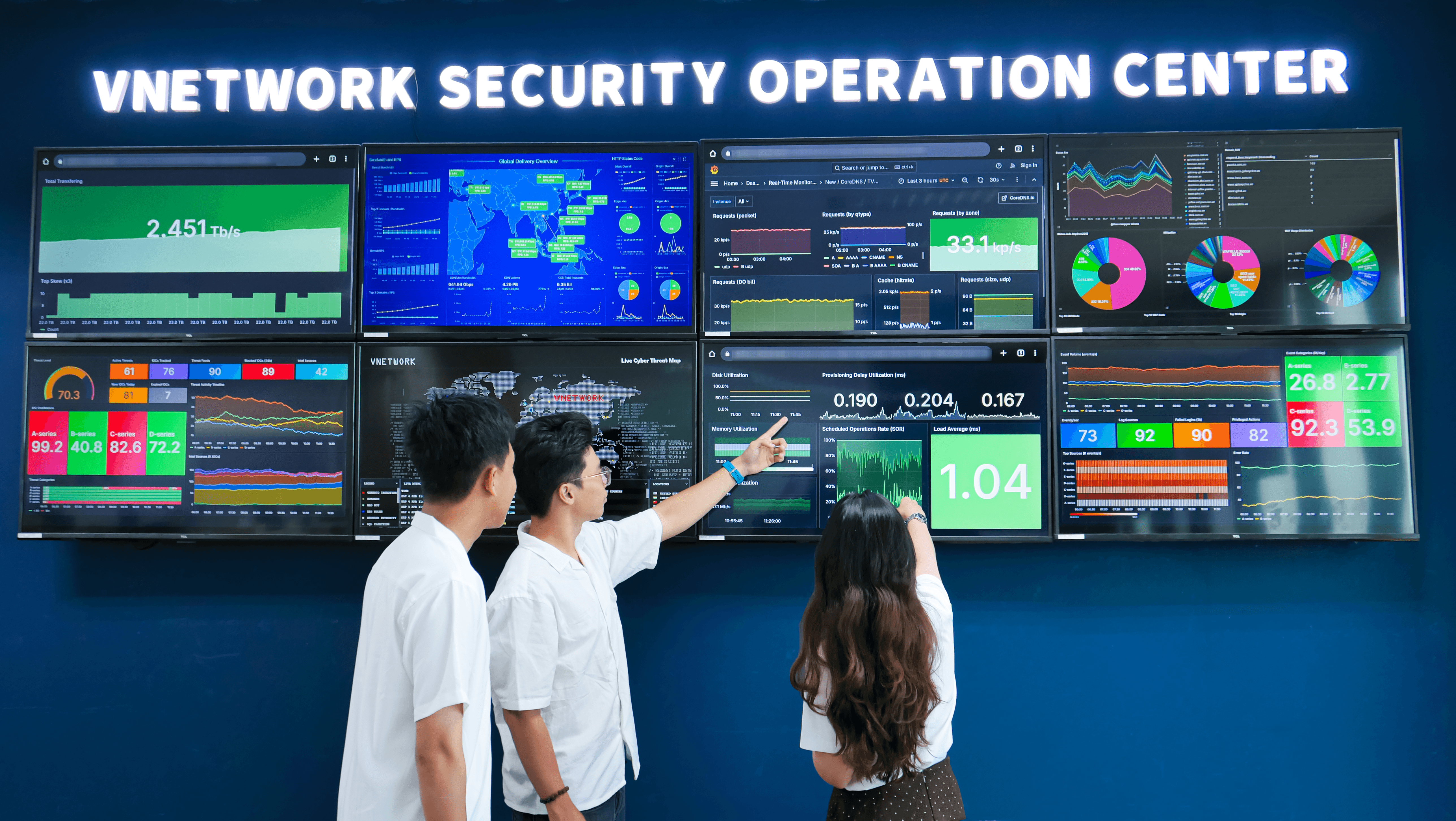
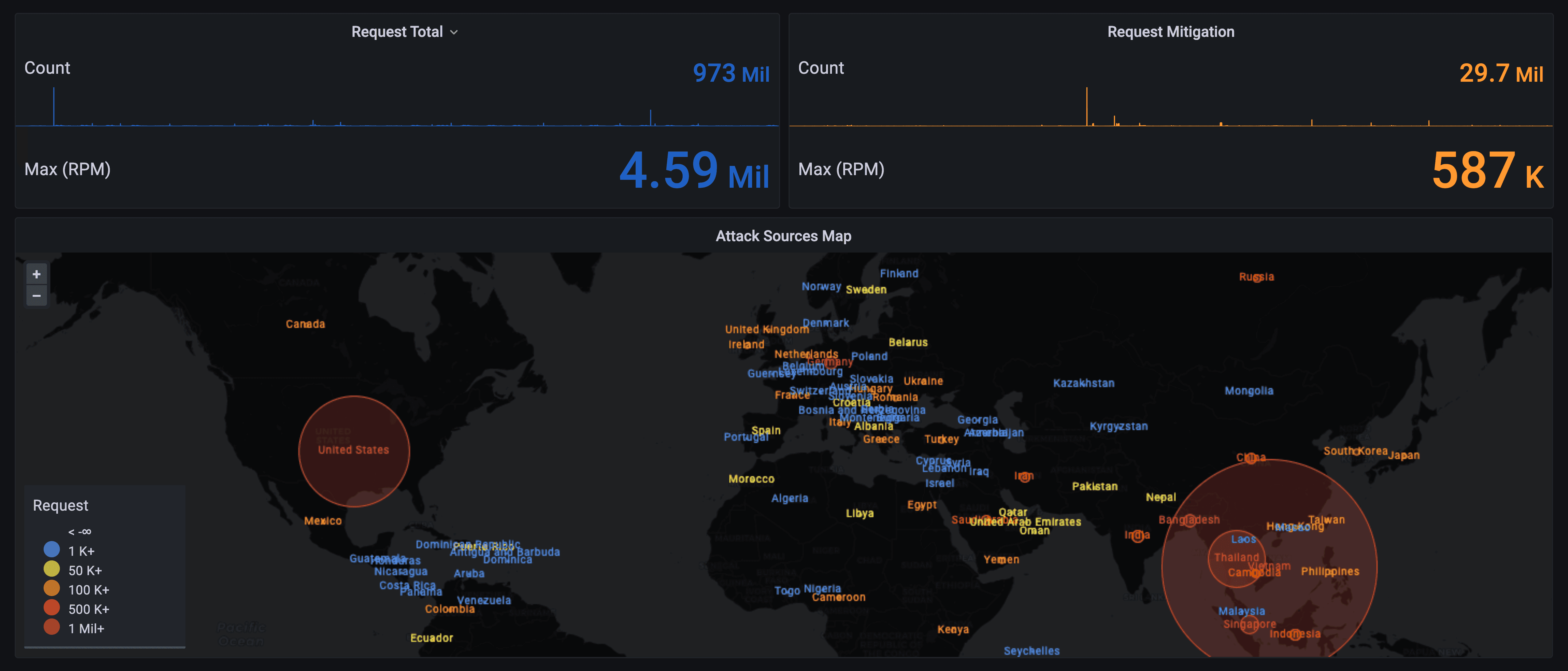
Beyond handling alerts, VNETWORK's SOC experts also conduct proactive threat hunting, searching for latent indicators of compromise that have not yet triggered an alert. All of this activity is supported by continuously updated Threat Intelligence from VNETWORK's global monitoring infrastructure and Live Cyber Threat Map, enabling Vietnamese enterprises to maintain a proactive defense posture against the latest attack campaigns.
SOC (Security Operations Center) is an indispensable foundation in any modern organization's security strategy. From continuous monitoring and threat detection to incident handling and compliance assurance, a Security Operations Center enables organizations to proactively protect their digital infrastructure against an ever-growing range of threats. Whether you choose in-house, managed, or hybrid, the key is to start building proactive security capabilities today. Contact VNETWORK for a consultation on the right SOC solution, available as an integrated capability within VNIS or EG-Platform, tailored to your organization's scale and needs.
A SOC (Security Operations Center) focuses on information security, monitoring and responding to cyber threats. A NOC (Network Operations Center) focuses on the performance and availability of network infrastructure. The two centers complement each other, and many large organizations operate both in parallel.
Yes. Small and medium-sized businesses are frequent attack targets precisely because their security capabilities tend to be more limited. Rather than investing in a costly in-house SOC, smaller organizations can opt for a Managed SOC to access professional-grade security capabilities at a manageable cost.
A 24/7 SOC means monitoring systems and on-call expert teams operate without interruption, including weekends and public holidays. When an incident occurs at 3 AM, the SOC team detects and responds immediately, following pre-established standardized procedures.
No. SIEM (Security Information and Event Management) is a technology that collects and correlates security data, and is one of the foundational tools a SOC uses. A SOC is an operations center encompassing people, processes, and technology; SIEM is just one component within it.
Deployment time depends on the SOC model. A Managed SOC can be activated within days to weeks after contract signing. An in-house SOC typically takes many months to complete the technology infrastructure, recruit and train staff, and establish operational procedures.