Security investment disconnected from protective efficiency
Many enterprises have invested in cybersecurity, yet the actual protective efficacy remains disproportionate. Only 33.7% of businesses have deployed multi-layered security models with integrated components. The remainder continues to operate siloed tools that do not share data, resulting in an actual defense level far lower than the capital invested.
This lack of connectivity creates "blind spots" between the very defense layers businesses believe they have in place. An endpoint alert that is not cross-referenced with email or VPN logs allows anomalous behavior to go undetected as a threat, even when appearing across multiple vectors. Attackers exploit this gap to move laterally within the infrastructure, escalating privileges and expanding control before the organization can respond. In reality, many ransomware attacks are not instantaneous but are the culmination of silent infiltrations lasting weeks or even months.
Attack landscape reflects defensive gaps
Survey data shows that the 2025 attack landscape directly mirrors the vulnerabilities within corporate security systems. DDoS leads with 57% of businesses affected, proving that network infrastructure remains the thinnest line of defense. Ransomware and malware were recorded at 41.3%, brute force attacks targeting VPNs and RDPs at 36.3%, and email phishing at 34.6%.
A common thread among these threats is that they do not require sophisticated techniques. Instead, they exploit exactly what businesses overlook: unmonitored access, non-standardized system configurations, and a lack of cybersecurity awareness training. Brute force is a prime example—simply cycling through passwords on VPNs and RDPs until successful. Once logged in, the session appears entirely legitimate and fails to trigger alerts without behavioral monitoring mechanisms. This is often the gateway to privilege escalation and, ultimately, ransomware.
Legal risks parallel technical risks
Cyberattack damages are no longer confined to operations. With Personal Data Protection Law No. 91/2025/QH15 now in effect, every user data breach can carry direct legal liability for executive leadership. However, research indicates that only 16.3% of enterprises have fully implemented personal data protection policies across their organizations. The remaining 83.7% are facing both technical risks and legal liabilities without adequate controls.
In other words, cybersecurity is no longer just an IT problem. When an incident occurs without fully implemented data protection policies, the question isn't just how to patch the system, but who is legally accountable. In this context, the cost of inaction will far outweigh the cost of proactive defense.
Integration over patchwork
VNETWORK’s research indicates that the core challenge is not a lack of market solutions, but rather the integration and maintenance of continuous operations. For organizations unable to build their own dedicated security teams, adding fragmented tools only complicates an already disjointed security ecosystem.
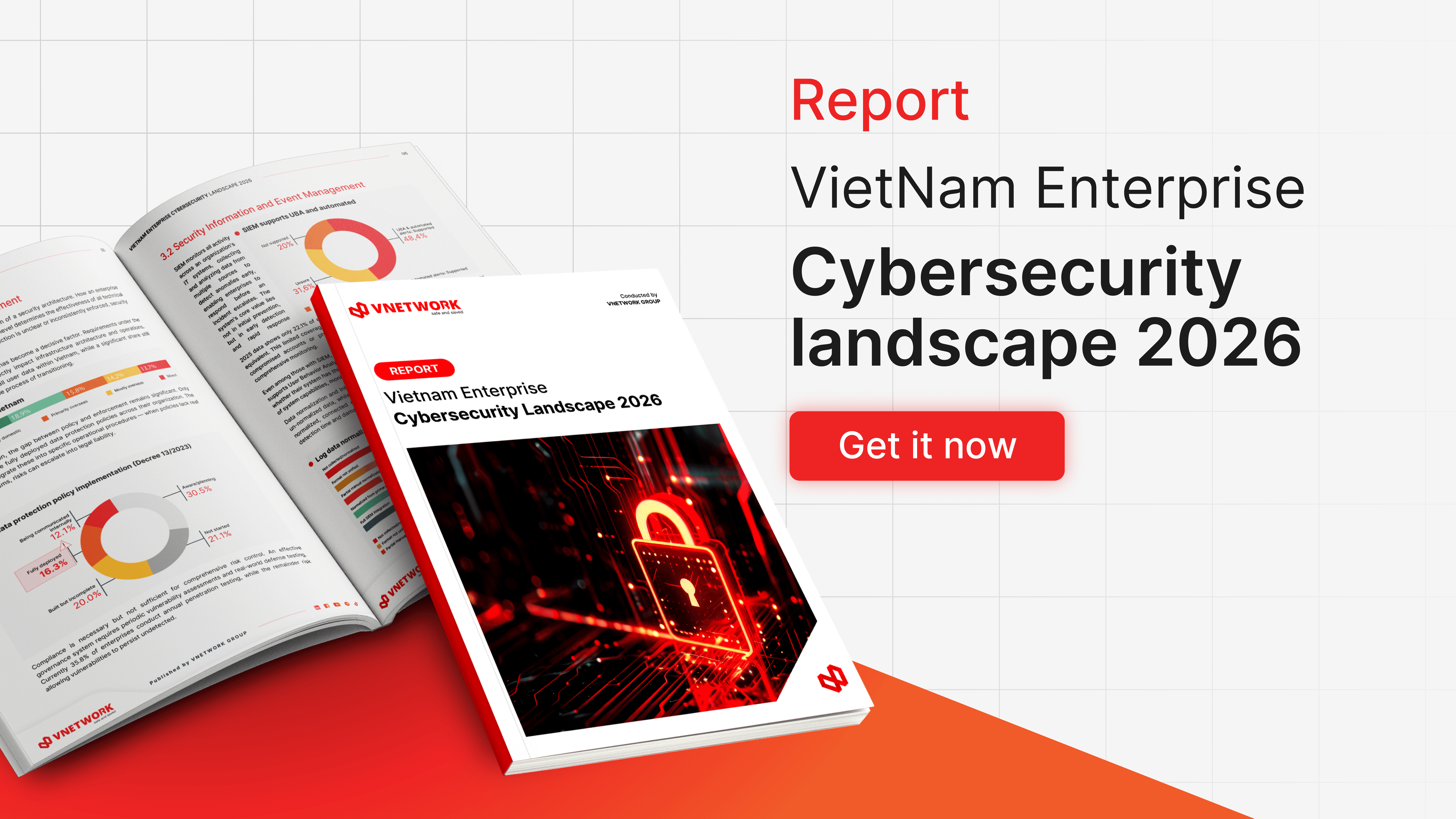
The starting point to solving this puzzle is understanding exactly where your system stands. The "Vietnam Enterprise Cybersecurity Landscape Report 2026" provides a deep dive into every defense layer, identifying specific vulnerabilities and offering practical recommendations for various scenarios. For organizations needing to reassess before making their next security investment, this is an indispensable resource.
View the full report and receive security consultations at:
- Hotline: 028 7306 8789
- Email: contact@vnetwork.vn