
1. What is cloud storage?
Cloud storage is a method of storing and managing data on remote servers that are accessed over the internet. Instead of being limited to local hard drives, personal computers, or on-premises servers, users and enterprises can store, retrieve, and manage data from any location with an internet connection.

Before cloud storage became widespread, data could only be accessed from a fixed physical location much like using a landline phone that only works at home. With cloud storage, data becomes as mobile as a smartphone: available anytime, anywhere, and across multiple devices. It frees users from expensive, space-constrained hardware while providing 24/7 access without carrying physical devices.
2. How cloud storage works
Cloud storage providers rent out space on their global networks of remote servers. Enterprises can:
- Store critical data
- Run applications or host services
- Perform backups and disaster recovery
Most providers offer a base storage quota, but capacity can be scaled instantly as needed. This eliminates large upfront hardware investments and delivers true pay-as-you-go elasticity.
3. Benefits of cloud storage
In today’s fast-paced digital transformation, simply having enough storage is no longer sufficient. Flexibility, security, and cost efficiency are equally critical. Cloud storage delivers all of these in one comprehensive solution.

3.1. Access data from anywhere
Users and teams can retrieve files from any device and location with an internet connection. Sharing documents with colleagues or partners becomes instant, without reliance on internal networks.
3.2. Effortless scalability
Instead of costly and time-consuming hardware upgrades, enterprises can increase storage capacity on demand, reducing both capital expenditure and IT overhead.
3.3. Superior data protection
On-premises storage is vulnerable to hardware failure, natural disasters, or human error. Cloud storage uses redundant storage across multiple servers and geographic locations, ensuring data remains safe and available.
3.4. Rapid data recovery
In case of incidents, data stored across distributed locations can be restored almost instantly, minimizing downtime and business disruption.
3.5. Cost optimization
Cloud storage eliminates expenses related to on-premises servers, power, cooling, and maintenance. Enterprises pay only for the capacity they actually use.
Cloud storage is far more than a place to keep files—it is a strategic enabler of flexibility, security, and cost efficiency in modern data management.
4. Types of cloud storage
Cloud storage comes in different architectures, each optimized for specific use cases and data volumes. The three most common types are file storage, block storage, and object storage.
4.1. File storage
Data is organized in a hierarchical folder structure with subfolders and metadata tags. Simple and cost-effective for moderate data volumes, but becomes harder to manage and scale as data grows significantly.
Analogy: Like a labeled filing cabinet easy to organize and find items when the volume is small, but cumbersome with thousands of files.
4.2. Block storage
Data is divided into fixed-size blocks, each with a unique identifier. The operating system treats these blocks as independent drives. Offers high performance and flexibility, ideal for large databases and virtual machines, though more expensive and with limited metadata support.
Analogy: Uniform plastic storage boxes that stack easily and can be placed anywhere perfect for large, growing collections.
4.3. Object storage
Each data unit (object) is stored as a single entity containing the data itself, rich metadata, and a unique identifier. Uses a flat, non-hierarchical address space, making it infinitely scalable and ideal for unstructured data (videos, images, backups, big data lakes).
Blob storage is a common form of object storage used for multimedia and large binary files.
Analogy: Every item in its own clearly labeled box finding anything is fast and simple, no matter how many items exist.
Choosing the right type depends on workload requirements, performance needs, and budget.
5. Is cloud storage secure?
One of the biggest concerns when migrating to cloud storage is data security. Reputable cloud storage providers implement multiple layers of protection to ensure data is never lost, corrupted, or accessed without authorization.
- Redundant storage: Data is automatically replicated and stored across multiple servers in different geographic locations. Even if one server experiences a hardware failure or power outage, data remains intact and accessible from other servers.
Example: When you back up your phone’s photo library to the cloud, multiple copies are stored on different servers worldwide. Even if your phone is damaged or one data center goes offline, your photos remain safe.
- Encryption and secure access: Data is encrypted both in transit and at rest. Access requires unique Access Key and Secret Key pairs, ensuring only authorized users can view or modify data.
- Granular access control: Permissions can be configured at the bucket or individual object level, restricting read/write access by user or application.
Moreover, providers like VNCDN integrate a Content Delivery Network (CDN) that not only accelerates data delivery and reduces latency but also shields origin servers from direct attacks.
When choosing a trusted provider and following best practices, cloud storage is not only flexible but also one of the safest data storage methods available today.
6. Cloud storage applications in enterprises
Cloud storage is far more than just a place to keep files; it is core infrastructure that enables smooth, flexible, and secure operations in the digital age. It provides optimal solutions across all industries thanks to its ability to handle big data, distribute content rapidly, and maintain high-level security.
- Websites and applications: Efficiently store web content, images, videos, and user-generated data while maintaining high performance and offloading origin servers.
- Video streaming & OTT platforms: Store and distribute large volumes of multimedia content with ultra-low latency, delivering smooth, high-quality viewing experiences.
- E-commerce: Handle high traffic volumes and frequent product updates, enabling faster page loads and seamless shopping experiences.
- Fintech: Ensure encrypted transaction data is stored securely and accessed instantly, with elastic scaling as user bases grow.
- E-learning: Host lectures, interactive materials, and student submissions, supporting sudden spikes in concurrent users without performance degradation.
- IoT and AI/ML: Store massive amounts of sensor data, images, and video for big data analytics and machine learning model training.
- Government services: Securely manage citizen databases, healthcare records, and public services with guaranteed availability.
- Gaming: Store graphics assets, player profiles, and real-time game states for uninterrupted online gameplay.
From e-commerce and online education to IoT and gaming, cloud storage is the flexible, secure, and efficient foundation for every enterprise on its digital transformation journey.
7. VNCDN cloud storage solution from VNETWORK
To meet modern enterprises’ demands for high-capacity storage, fast content delivery, and robust security, VNETWORK offers Cloud Storage S3, a comprehensive, easy-to-deploy solution suitable for businesses of all sizes.
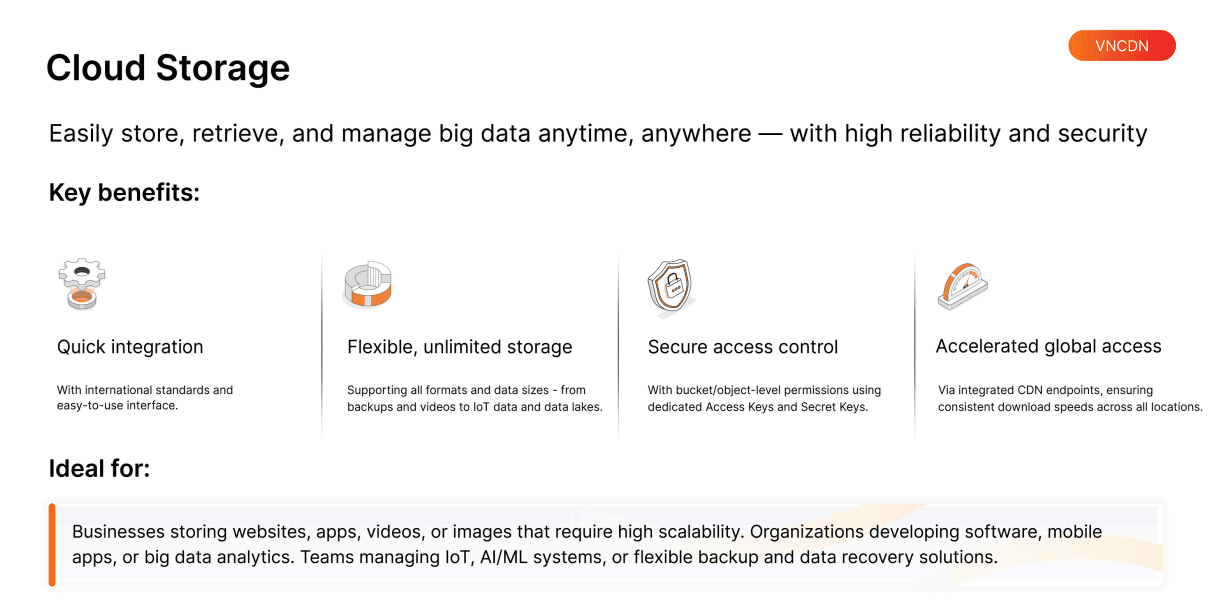
Rapid integration
Fully compatible with international S3 standards and common protocols, allowing instant deployment and management with minimal technical resources.
Unlimited flexible storage
Supports all data types including backups, video, images, system logs, IoT data, and data lakes. Capacity scales without limits according to real-time needs, eliminating hardware upgrade costs.
Absolute security
Every bucket and object is protected with granular permissions and unique Access Key/Secret Key pairs, giving enterprises full control over who can view, download, or modify data.
Built-in global acceleration
Every storage endpoint is directly backed by VNCDN’s integrated CDN, delivering content from the nearest edge location with consistently high speed, even during traffic spikes.
VNCDN operates a global infrastructure with over 2,300 PoPs across 146 countries and more than 200 Tbps of international bandwidth. The platform supports low-latency delivery, cost optimization, advanced access control, full API integration, HTTP/3 & QUIC, Origin Shield, and multi-CDN architecture. The entire system is monitored 24/7 by a professional SOC team, ensuring maximum stability and security.
With this powerful foundation, enterprises can effortlessly publish online content, scale e-commerce platforms, deliver smooth OTT services, operate secure fintech applications, and accelerate online education, all while improving website performance and global user experience.
8. VNCDN: The leading cloud storage provider in Vietnam and Asia
With modern infrastructure and experience serving hundreds of enterprises, VNCDN has become the trusted choice for organizations seeking high-speed, secure, and cost-effective cloud storage.
- Over 12 years of experience: Serving more than 500 domestic and international customers across e-commerce, digital government, fintech, and online entertainment.
- High-performance infrastructure: Powered by enterprise-grade SSD storage and NVMe+ connectivity for ultra-fast data transfer and 100% uptime.
- Integrated security and acceleration: Combined with VNIS protection against DDoS attacks, efficient data management, and accelerated page loading.
- Suitable for all business sizes: From SMEs to large corporations, VNCDN offers flexible, scalable packages that optimize long-term operational costs.
With proven expertise, cutting-edge infrastructure, and comprehensive security, VNCDN is the strategic partner for enterprises seeking the optimal cloud storage solution in Vietnam and across Asia.
Conclusion
Cloud storage is the modern solution that helps enterprises manage large-scale data securely, quickly, and flexibly. With powerful features and full support from VNETWORK’s VNCDN platform, businesses can enhance operational efficiency, reduce costs, and deliver superior user experiences worldwide.
Investing in cloud storage today is a strategic move that positions enterprises for success in digital transformation and global integration.
FAQ: Frequently asked questions about cloud storage
1. What is cloud storage?
Cloud storage is a method of storing data on remote servers accessible via the internet, allowing enterprises to store, share, and manage data anytime, anywhere.
2. Who should use cloud storage?
Enterprises that need to store websites, videos, applications, IoT data, AI/machine learning workloads, e-commerce platforms, or require flexible backup and disaster recovery.
3. What are the main benefits of cloud storage?
Access from anywhere, instant scalability, high security, rapid disaster recovery, and significant operational cost savings.
4. Is cloud storage secure?
Yes, absolutely, when used correctly. Data is protected by multiple layers including encryption, granular access controls, and redundant storage across geographically distributed servers. This ensures data remains safe even if one server fails and minimizes risks of unauthorized access.
5. What cloud storage solutions does VNCDN provide?
VNCDN offers S3-compatible cloud storage with integrated global CDN, multi-CDN, Origin Shield, HTTP/3 & QUIC, full API support, VNIS security, website acceleration, and low-latency worldwide content delivery.