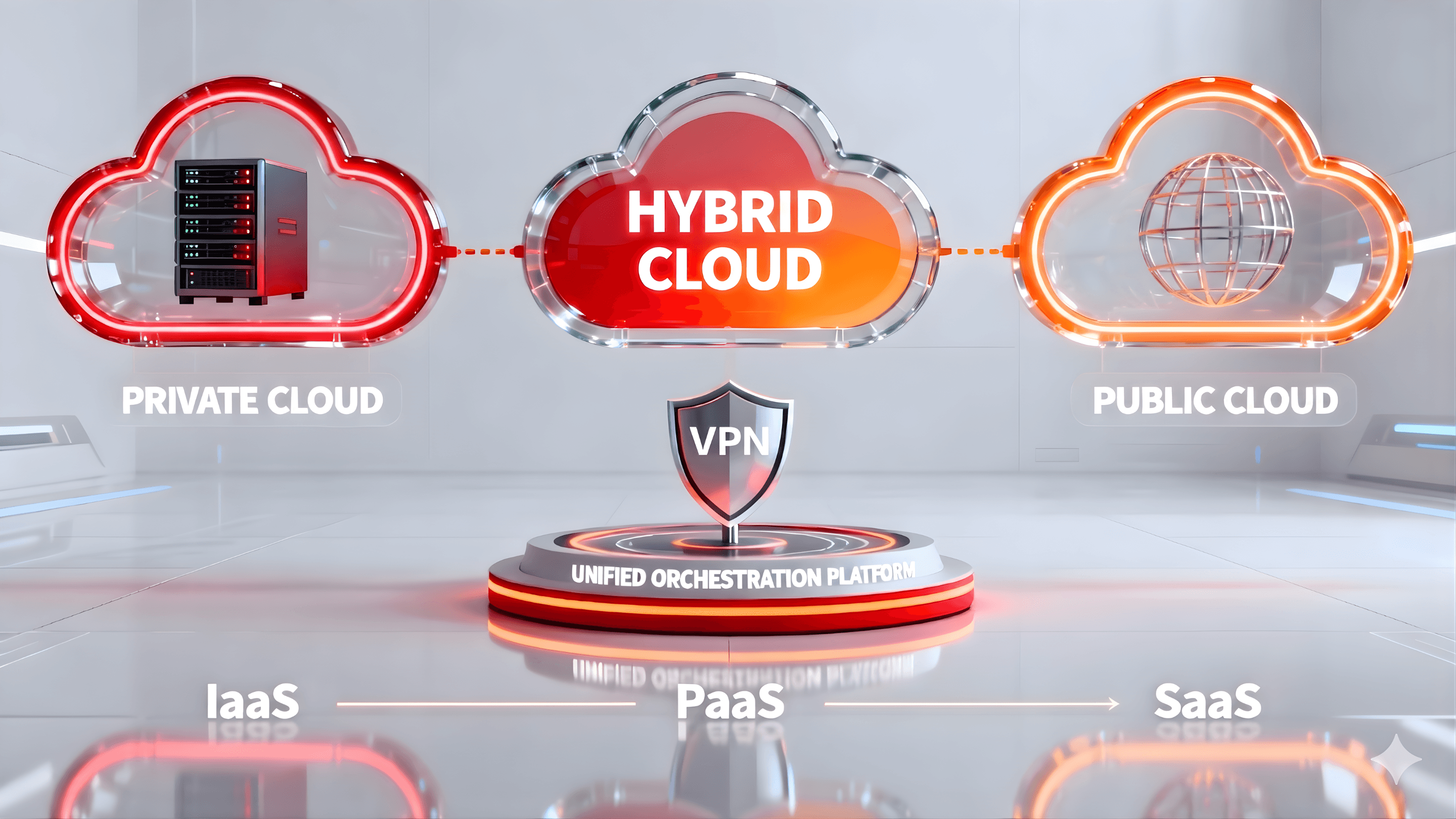
Hybrid cloud, also known as a mixed cloud, is an infrastructure model that combines at least two different computing environments, typically a private cloud or on-premises data center with a public cloud. These two environments are connected through networking technologies and APIs, allowing data and applications to move flexibly between them based on actual needs.
The core distinction of hybrid cloud compared to other models is its interoperability: the two environments do not operate independently but work closely together, enabling businesses to orchestrate workloads intelligently and efficiently. To better understand the differences between models, you can read more about comparing public cloud, private cloud, and hybrid cloud.
The three popular cloud computing models today can be distinguished as follows:
| Criteria | Public Cloud | Private Cloud | Hybrid Cloud |
|---|---|---|---|
| Infrastructure | Provider-operated, shared | Dedicated to one organization | Combines both environments |
| Security | Limited control | High control, better security | Flexible per data type |
| Cost | Low, pay-as-you-go | Large initial investment | Optimized overall long-term |
| Scalability | Easy and fast | Depends on internal infrastructure | Flexible, elastic on demand |
A complete hybrid cloud architecture typically includes the following components:
Businesses do not need to invest in full physical infrastructure for maximum capacity that is only needed at certain peak times. Instead, the stable baseline workload is handled by internal infrastructure, while traffic spikes are scaled out to public cloud on a pay-per-use basis. This approach avoids wasting resources that have been invested but sit idle most of the time.
Businesses with highly variable traffic during seasonal periods, events, or marketing campaigns benefit greatly from cloud bursting. The system can automatically scale up or down in minutes instead of waiting weeks to procure additional physical servers. This is also why cloud computing is increasingly regarded as the backbone of long-term infrastructure strategy.
Hybrid cloud allows businesses to keep sensitive data on a tightly controlled internal environment while still leveraging cloud computing for less sensitive tasks. This is particularly important in the context of the Data Law 2024 and the Personal Data Protection Law, which impose increasingly strict requirements on user data storage and processing in Vietnam.
Businesses in highly regulated sectors must pay special attention to complying with the Cybersecurity Law, which sets out specific requirements regarding in-country data storage and control of cross-border information flows.
The hybrid cloud model naturally creates redundancy between the two environments. When one environment encounters an issue, workloads can be shifted to the other, minimizing downtime and service disruption.
Backup and disaster recovery strategies also become more effective when data is automatically backed up to cloud storage, independent of physical on-site storage infrastructure.
Operating multiple environments simultaneously requires a technical team with expertise in both on-premises infrastructure and cloud computing. A lack of centralized management tools can lead to difficulties in monitoring, performance optimization, and cost control. This is why many businesses choose to partner with experienced service providers rather than managing everything in-house.
The connectivity layer between on-premises and public cloud is a point that requires special protection. If not tightly controlled, it can become a vulnerability that attackers exploit to infiltrate systems, deploy malware, ransomware, or cause serious data breaches.
A cloud security strategy in a hybrid environment must be built on the Defense in Depth principle, combining encryption, access control, and continuous multi-layer monitoring. One effective approach is implementing a Zero Trust model, where no entity is implicitly trusted regardless of whether it is inside or outside the internal infrastructure.
Successfully deploying and operating hybrid cloud requires a team that thoroughly understands distributed architecture, network management, cloud security, and infrastructure automation. This presents a significant challenge for businesses without prior experience in this area, particularly when they must maintain legacy systems while building new infrastructure simultaneously.
| Use case | Characteristics | Example industries |
|---|---|---|
| Strict data compliance requirements | Must store data locally per regulations, yet still need cloud services for other tasks | Finance, banking, insurance, healthcare, education |
| Highly variable traffic workloads | Peak load changes significantly by season or event, requiring rapid elasticity | E-commerce, ticketing, media, retail, logistics |
| Undergoing digital transformation | Migrating applications from traditional infrastructure to cloud on a phased roadmap | Mid-size and large enterprises transforming infrastructure |
Organizations in finance, banking, insurance, and healthcare typically must store customer data on internal infrastructure per regulatory requirements. Hybrid cloud allows them to still benefit from cloud services for analytics, reporting, or internal applications that do not contain sensitive data. This model is also ideal for cloud for healthcare with its strict security and compliance requirements, as well as cloud for education where student data must be rigorously protected.
E-commerce platforms, event ticketing systems, and media applications often experience highly fluctuating traffic. Hybrid cloud helps these systems handle peak loads effectively without having to maintain large-scale infrastructure year-round. This model is also very well suited for cloud for retail and cloud for logistics where data processing demand changes continuously based on seasonal patterns and business activity.
For businesses gradually migrating from traditional infrastructure to the cloud, hybrid cloud serves as a logical intermediate step. Rather than migrating everything at once, businesses can transition applications one by one according to a roadmap, minimizing the risk of disruptions. Successful digital transformation typically begins with careful, well-planned steps like these.
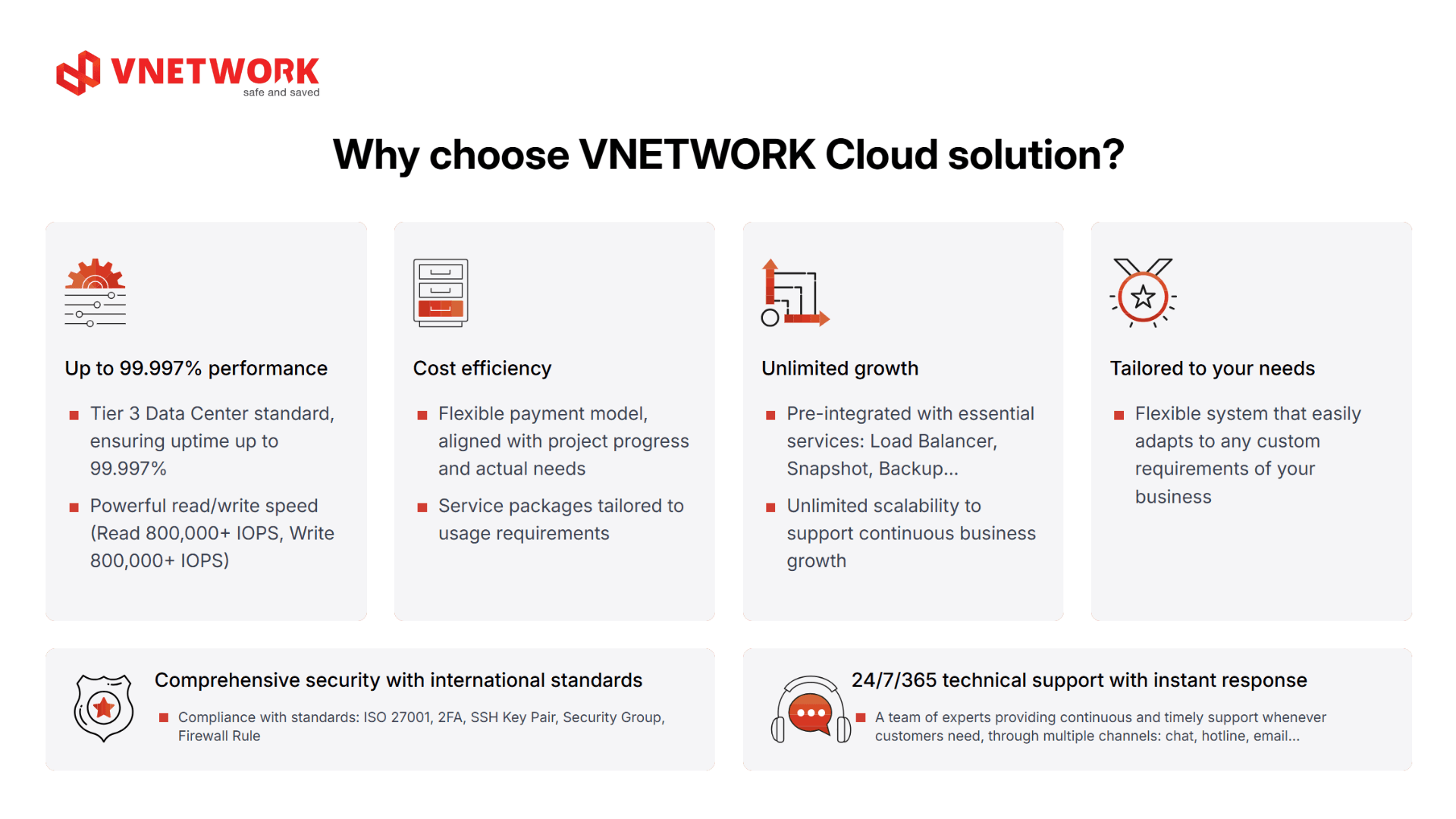
VCLOUD is VNETWORK's cloud computing platform, built to meet the need for flexible, high-performance, and cost-efficient digital infrastructure for businesses of all sizes. Transparent pricing with no unexpected costs helps businesses manage budgets proactively even in volatile market conditions. From a legal standpoint, VCLOUD fully complies with the Personal Data Protection Law, operates on a data center certified to international Tier III standards, and guarantees uptime of up to 99.997%, making it suitable for high-traffic websites, e-commerce, and AI/Big Data systems.
In terms of security, VCLOUD is built with multi-layer protection certified to ISO 27001, integrating firewall, Security Group, two-factor authentication (2FA), SSH Key Pair, and granular permissions by team or project. The infrastructure supports Kubernetes and load balancing to optimize performance as systems scale, combined with scheduled backups and rapid snapshots to minimize the risk of data loss. From SMEs to enterprises, VCLOUD provides abundant resources that are ready to scale along each organization's growth roadmap, backed by a 24/7/365 expert support team that advises and tailors solutions to real-world needs.
Hybrid cloud is a combined infrastructure model that bridges the on-premises environment and the cloud, delivering an optimal balance between security, cost, and operational flexibility. With the ability to tightly control sensitive data while harnessing the power of cloud technology, it is a suitable choice for many businesses on their digital transformation journey.
Hybrid cloud is a model that combines on-premises server infrastructure (or private cloud) with public cloud services, allowing data and applications to move flexibly between the two environments based on business needs.
Hybrid cloud combines an on-premises or private cloud environment with a public cloud and emphasizes interoperability between the environments. Multi-cloud is a strategy of using multiple public cloud providers simultaneously, without necessarily having direct connectivity or data synchronization between them.
Hybrid cloud is better suited to mid-size and large businesses due to the required investment in internal infrastructure and technical talent. However, small businesses can start with a simpler model, such as combining a single on-premises server with a cloud storage service, and expand gradually as needs grow.
The initial cost of hybrid cloud is typically higher than using only public cloud, as internal infrastructure investment is required. However, in the long run, this model helps optimize overall costs by using cloud resources only when truly necessary, rather than paying fixed fees for full capacity at all times.
Hybrid cloud security requires a multi-layer approach: encrypting data both in transit and at rest, enforcing strict access control based on the principle of least privilege, continuously monitoring connection points between the on-premises and cloud environments, and applying consistent security policies across both environments.