
A security vulnerability is a weakness in software, hardware, operational processes, or system configurations that an attacker can exploit to gain unauthorized access, steal data, or disrupt an organization's operations. Vulnerabilities do not necessarily stem from complex programming errors; sometimes a simple misconfiguration or an unchanged default password is enough to create an entry point for an attack.
To better understand the concept, it is important to distinguish four commonly confused terms:
These four elements are closely connected: a vulnerability exists, a threat emerges, an exploit is executed, and risk materializes.
Security vulnerabilities do not appear spontaneously; they arise from various sources throughout the software development and system operations lifecycle. Understanding their root causes is the first step toward building an appropriate prevention strategy.
Understanding common vulnerability types helps businesses allocate protective resources where they matter most. The following five groups are the most frequently exploited in enterprise environments.
Web applications represent the broadest attack surface because they are directly exposed to the internet. SQL Injection allows attackers to insert malicious SQL statements into input forms to retrieve or delete database data. Cross-Site Scripting (XSS) enables injection of malicious JavaScript into web pages to steal user session cookies. Cross-Site Request Forgery (CSRF) tricks a user's browser into sending unauthorized requests to an application they are logged into. Server-Side Request Forgery (SSRF) allows attackers to manipulate a server into sending requests to internal services that are normally inaccessible from outside. Insecure Deserialization occurs when an application processes serialized data from an untrusted source, enabling remote code execution.
Operating systems and application software contain millions of lines of code, creating opportunities for errors during development. Vulnerabilities in this category typically involve buffer overflow, privilege escalation (allowing attackers to elevate from a regular user to an administrator), or flaws in network protocols and system services. These vulnerabilities often carry high CVSS scores because they directly impact the entire system rather than a single application.
Application Programming Interfaces (APIs) are increasingly becoming popular targets because APIs connect directly to critical data and business logic. API vulnerabilities commonly stem from weak token authentication, lack of rate limiting, sensitive information leakage in API responses, or Broken Object Level Authorization (BOLA) that allows users to access data belonging to other entities beyond their authorization scope. For financial and e-commerce businesses operating multiple partner-facing APIs, risks from this vulnerability group warrant particular attention.
Insufficient authentication and loose authorization controls create vulnerabilities that allow attackers to access unauthorized resources. Broken Authentication occurs when a system permits weak passwords, has no account lockout mechanism after multiple failed login attempts, or fails to properly protect user sessions. Broken Access Control occurs when users can access data or functionality outside their granted permission scope. Attackers exploit these vulnerabilities to access customer data, alter system configurations, or perform actions with higher privileges than originally granted.
A zero-day vulnerability is one that the software vendor has not yet discovered or for which no patch exists. The term "zero-day" reflects the reality that developers have "zero days" to address the issue before it is exploited. This is the most dangerous class of vulnerability because no direct remediation can be applied immediately, forcing organizations to rely on proactive defense layers such as behavioral anomaly monitoring and AI-driven analysis to detect exploitation indicators early.
Understanding the exploitation process from the attacker's perspective helps organizations identify exactly where to disrupt the attack chain for the most effective defense.
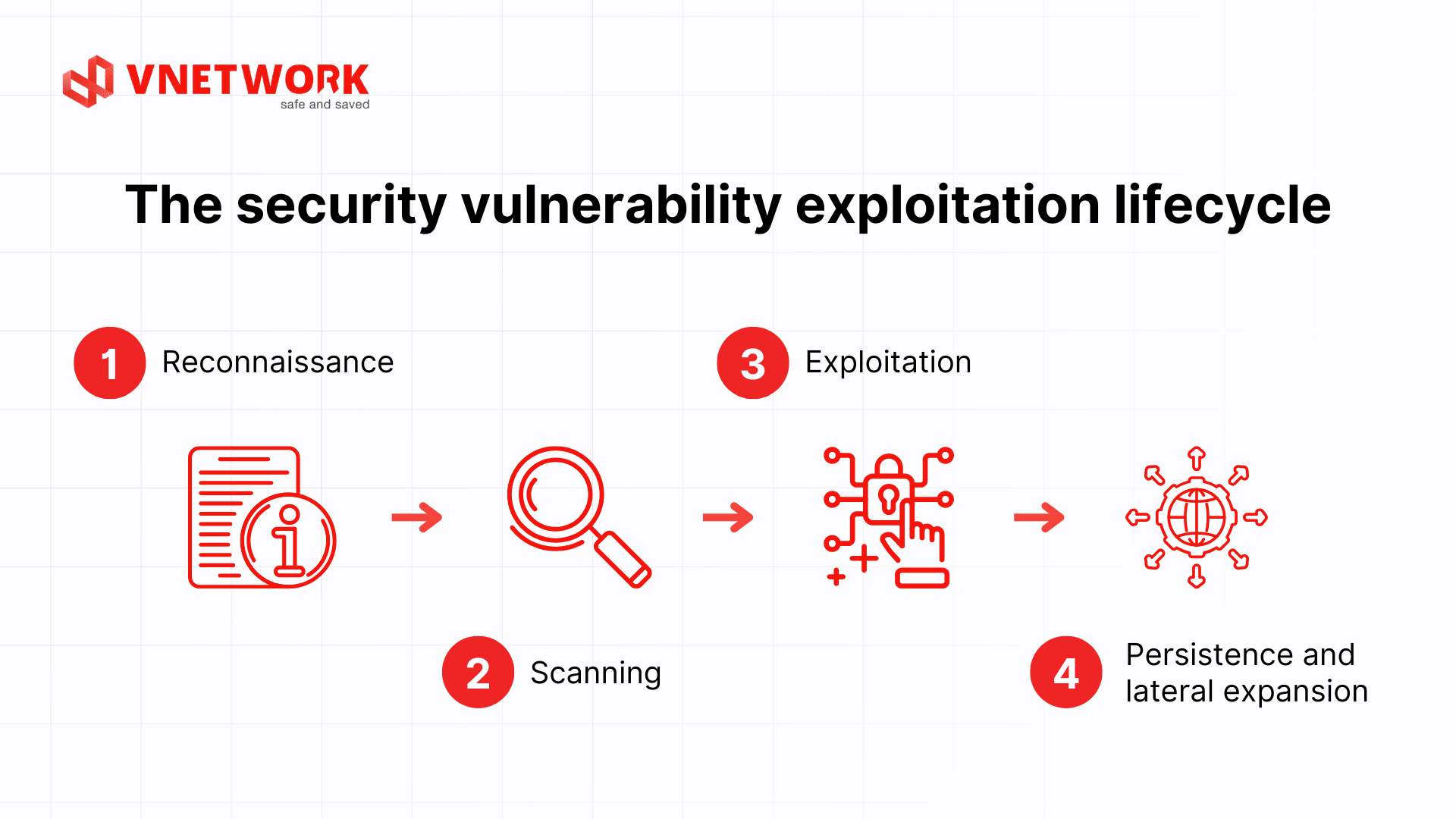
Phase 1: Reconnaissance. Before attacking, the intruder gathers information about the target: domain names, system architecture, software versions in use, public accounts, and errors disclosed through reconnaissance. This phase is typically silent and difficult to detect because it does not directly interact with the system.
Phase 2: Scanning. The attacker uses automated tools to scan services, open ports, and software on the target system, cross-referencing results against known vulnerability databases (CVE) to identify exploitable weaknesses. Systems slow to apply patches are the easiest targets at this stage.
Phase 3: Exploitation. The attacker executes exploit code targeting the identified vulnerability. For web application vulnerabilities such as SQL Injection or XSS, exploitation can be carried out through an ordinary browser without specialized tools. For operating system or API vulnerabilities, dedicated tools are used to precisely target the weakness.
Phase 4: Persistence and lateral expansion (Post-exploitation). After a successful breach, the attacker does not leave immediately but seeks to maintain long-term access: installing rootkits or backdoors, performing lateral movement to other systems within the internal network, and escalating privileges to gain administrative control. This phase can persist for weeks or months before being detected.
The average time between an attacker's initial intrusion and an organization's detection is referred to as "dwell time." The longer the dwell time, the greater the damage, as attackers have more opportunity to collect data, move laterally within the system, and erase their tracks. Reducing dwell time through continuous monitoring is therefore a top priority in modern security strategy.
When a security vulnerability is successfully exploited, the consequences extend far beyond technical damage. In sensitive industries such as finance, securities, insurance, and e-commerce, the impact can spread widely and persist for years.

Effective vulnerability prevention requires a multilayered approach combining technical controls, operational processes, and human awareness. The Defense in Depth model is the foundational principle: no single layer of protection is absolute, so multiple independent layers are needed to limit damage when one layer is breached.
Organizations must establish a disciplined vulnerability management process rather than addressing issues reactively. The process follows four key steps:
The Shift Left Security principle encourages integrating security testing from the earliest development stages rather than only detecting issues after deployment. The earlier a vulnerability is found, the lower the remediation cost and the smaller the exploitation risk.
The Least Privilege principle requires that each account, service, or application be granted only the permissions necessary to perform its specific function. Combined with multi-factor authentication (MFA), rigorous identity management, and prompt access revocation when no longer needed, this approach limits the blast radius when an account is compromised. The Zero Trust model goes further: no user or device is inherently trusted, even within the internal network. Every access request must be authenticated and authorized each time, significantly reducing the risk of lateral movement after an attacker breaches the perimeter.
Deploying a Web Application Firewall (WAF) is the core protective layer for all web applications and APIs. A WAF analyzes traffic in real time, detecting and blocking malicious requests that exploit vulnerabilities before they reach the application server. WAAP (Web Application and API Protection) is the next generation of WAF, extending coverage to include bots, Layer 7 DDoS, and AI-driven behavioral analysis to detect more sophisticated attacks. Continuous 24/7 monitoring via SIEM systems and a SOC team enables early dwell time detection at the first sign of anomalous behavior, rather than waiting until damage has occurred. Combining behavioral monitoring with automated alerting minimizes response time.
Establishing a clear patch management policy ensures all software and systems are updated on a regular schedule, with high CVSS-scored items prioritized. Combined with regular penetration testing, this approach surfaces weaknesses before attackers discover them. Security awareness training for all staff, with a particular focus on recognizing phishing and social engineering tactics, is an indispensable element for addressing the human dimension of the threat landscape.
In a complex cyber risk environment, protecting systems cannot rely on fragmented tools alone. The VNIS (VNETWORK Internet Security) solution provides an integrated security platform that helps organizations proactively address vulnerabilities through a two-layer protection model:
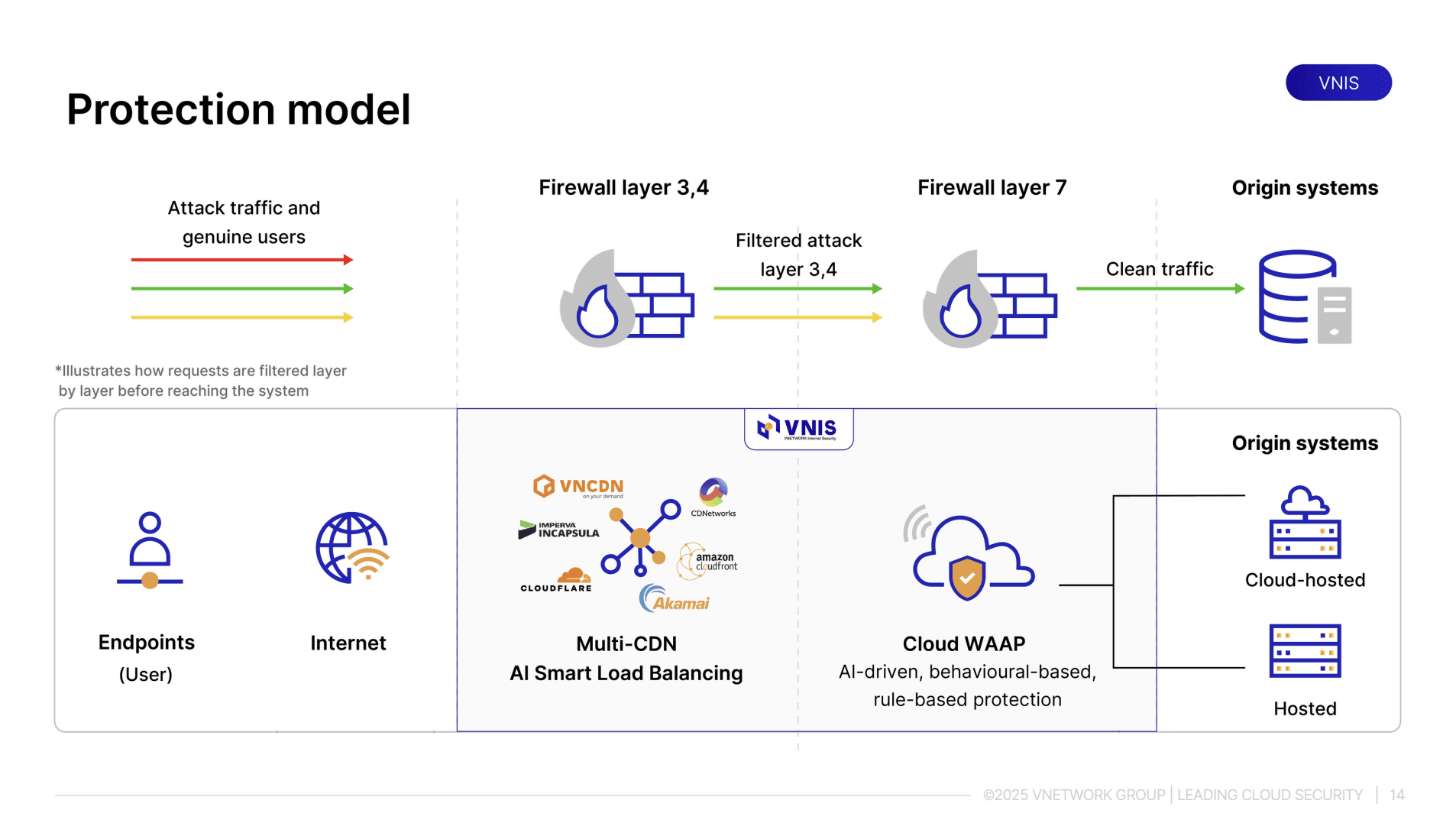
Key advantages of deploying VNIS:
Security vulnerabilities are an inevitable reality in today's complex technology environment, yet they are entirely manageable if organizations proactively identify, monitor, and respond to them in a timely manner. Understanding where vulnerabilities originate, how attackers exploit them, and which protective layers to prioritize enables organizations to build evidence-based security strategies rather than reacting defensively. Particularly for organizations in finance, securities, insurance, and e-commerce, a comprehensive security strategy is no longer optional; it is a mandatory requirement. Contact VNETWORK for tailored security solution consulting aligned with your organization's scale and operational needs.
A security vulnerability is a weakness that exists within a system, whereas a threat is an actor or action capable of exploiting that weakness. Simply put, a vulnerability is an "open door" and a threat is the party that can walk through it. Security risk materializes when both elements are present, and an exploit is the action that turns a latent vulnerability into real-world damage.
The CVSS (Common Vulnerability Scoring System) score is a scale from 0 to 10 that evaluates the severity of a vulnerability based on factors such as remote exploitability, complexity, required privileges, and impact level. Organizations should prioritize patching vulnerabilities with a CVSS score of Critical (9.0 and above) and High (7.0 to 8.9) first, particularly those affecting systems directly exposed to the internet or storing sensitive data.
A zero-day vulnerability is one that the software vendor has not yet discovered or for which no patch exists. During this "blind window," the only direct mitigation is behavioral anomaly monitoring and AI-driven analysis to detect exploitation indicators early. Organizations can supplement this with compensating controls such as disabling unnecessary services, tightening access permissions, and increasing monitoring intensity while awaiting an official patch.
Small and medium-sized businesses are actually more likely to become targets precisely because they typically lack dedicated security resources. Attackers are well aware of this and actively target organizations with thinner defenses. Using an integrated security platform such as VNIS gives smaller businesses a professional layer of protection with automated operation capabilities and a 24/7 SOC monitoring team, without requiring a large internal IT department.
Organizations can detect vulnerabilities through three primary methods: automated vulnerability scanning using dedicated DAST/SAST tools, periodic penetration testing conducted by security specialists, and real-time behavioral anomaly monitoring within the system. Combining all three approaches provides the earliest possible vulnerability detection, before attackers have the opportunity to exploit them.