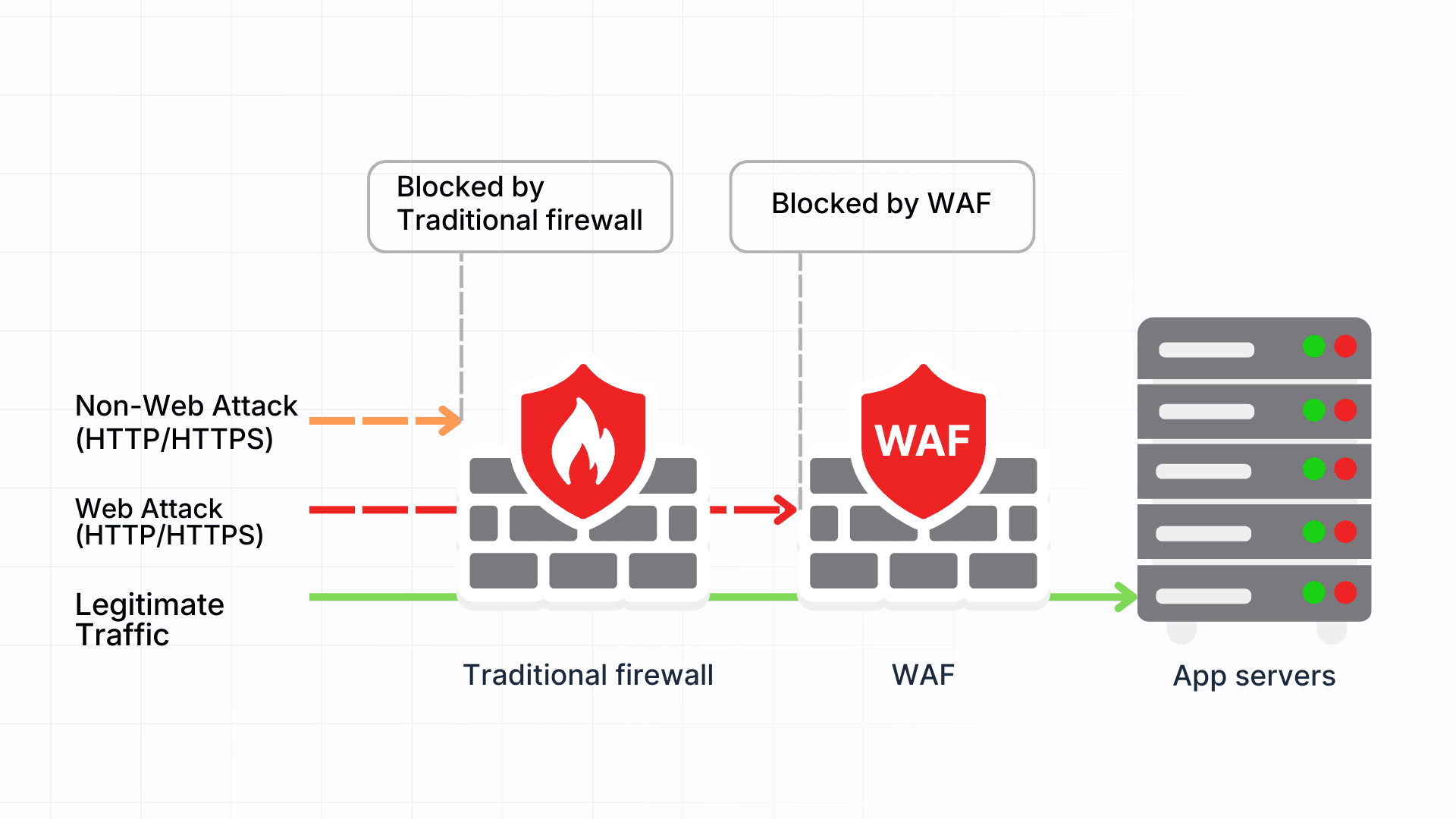
WAF is a specialized security solution focused on protecting web applications and APIs from attacks that target an application's processing logic directly. WAF inspects the content of every HTTP and HTTPS request in depth, detecting anomalies in parameters, cookies, headers, or payload content. This deep inspection lets WAF identify and block attacks that a traditional firewall cannot see at all, since these attacks pass through legitimate ports and protocols.
Firewall, also known as a network firewall, is a security device or piece of software that acts as a control barrier between a business's internal network and the outside internet. A traditional firewall operates on preset rules, checking the source IP address, connection port, and transport protocol to decide whether to allow or block a connection. Its main goal is to prevent unauthorized access to the internal network, protecting servers, devices, and data from unauthorized external connections.
The core difference between the two solutions lies in which layer of the OSI model they operate at. A traditional firewall mainly operates at Layer 3 and Layer 4, controlling traffic based on IP address, connection port, and TCP/UDP protocol. WAF, on the other hand, operates at Layer 7, the application layer, where the content of HTTP/HTTPS requests sent by users to a website or application is processed directly.
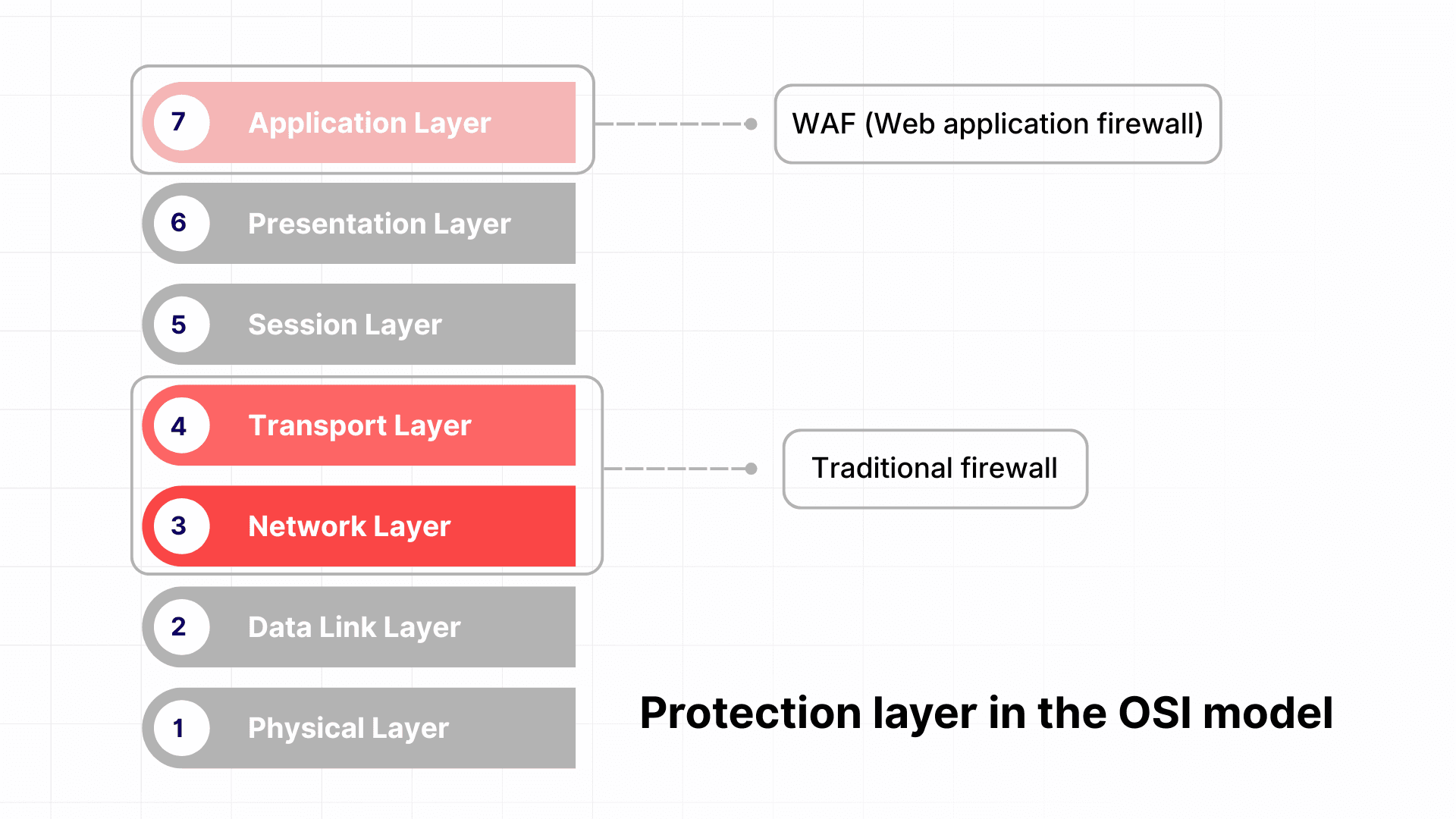
A traditional firewall controls traffic at the network level, relying on connection identifiers such as source and destination IP address, port number, and protocol, without examining the content inside the packet. WAF, in contrast, controls traffic at the application level, reading and analyzing the actual content of a request, including the URL path, query parameters, headers, cookies, and request body. This lets WAF detect abnormal behavior hidden inside a request that otherwise looks valid at the network layer.
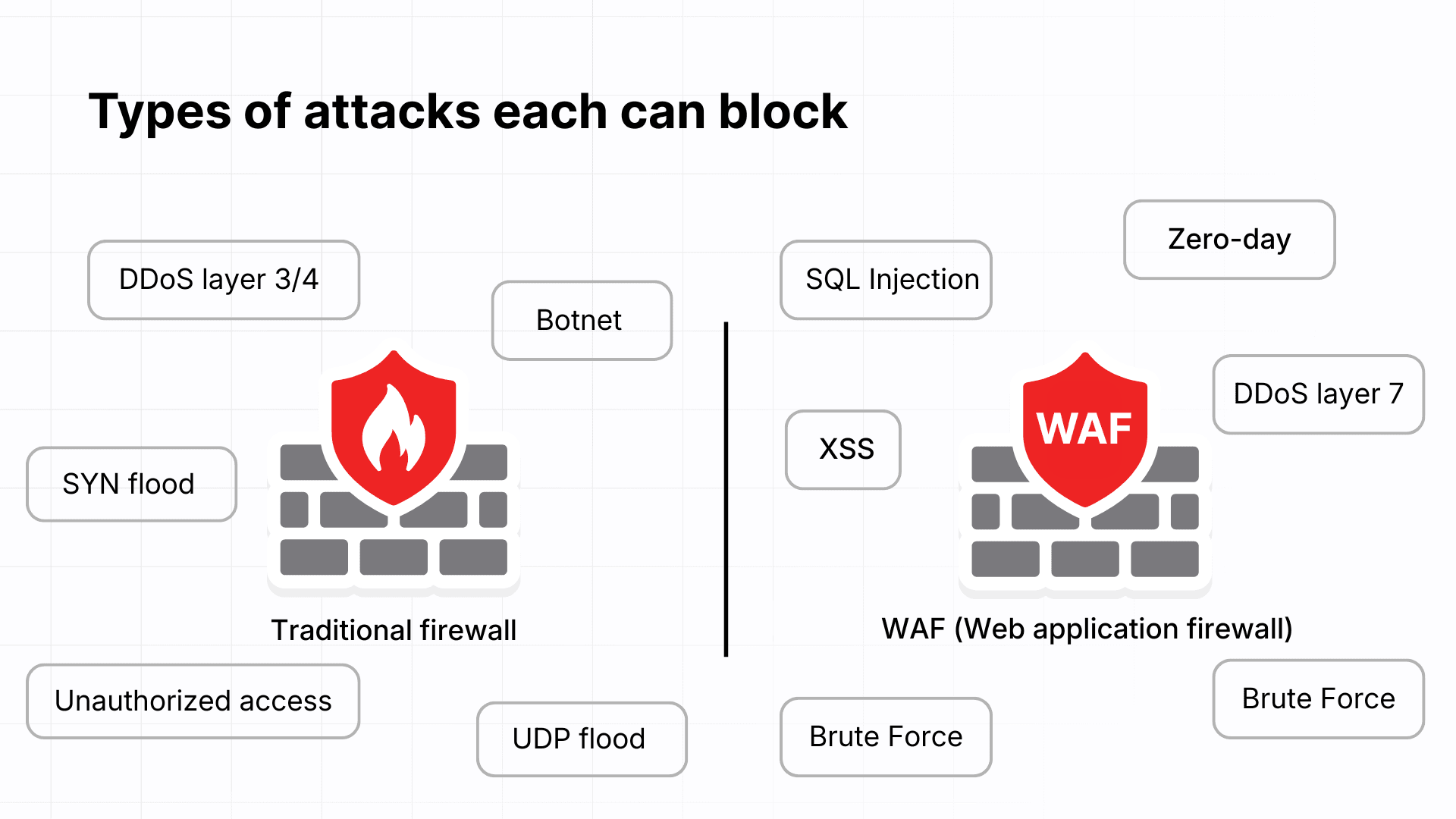
WAF is designed to block attacks that target web application vulnerabilities, most commonly SQL injection, XSS, and vulnerabilities listed in the OWASP Top 10. A traditional firewall, by contrast, focuses on blocking unauthorized access to the network, controlling connections from untrusted IP addresses, and reducing the risk of intrusion from botnets. Certain network layer DDoS attacks also fall within the scope of a traditional firewall, while application layer DDoS requires WAF for accurate detection.
A traditional firewall is typically deployed at the network perimeter, serving as the first line of defense before traffic enters the internal system. WAF sits closer to the web application, working as a reverse proxy between users and the application server to inspect every request before it reaches the actual processing logic. Many modern WAF solutions also integrate rate limiting to cap the number of requests from a single source, combined with WAAP mechanisms to extend protection to APIs as well.
A traditional firewall protects a business's entire network infrastructure, including servers, internal devices, databases, and other network services operating behind the security perimeter. WAF focuses on a narrower but deeper scope, specifically web applications and APIs that are directly exposed to external users. Because their protection scopes differ, a business cannot use one solution as a complete substitute for the other.
| Criteria | Traditional Firewall | WAF |
| Other name | Network Firewall | Web Application Firewall |
| Protection layer (OSI) | Layer 3, Layer 4 | Layer 7 |
| Traffic controlled | IP address, port, protocol | HTTP/HTTPS request content (URL, parameters, headers, cookies) |
| Protection scope | Entire network infrastructure (servers, devices, internal databases) | Website and API |
| Deployment position | Network perimeter | Reverse proxy in front of the application |
| Attacks blocked | Unauthorized access, botnets, network layer DDoS | SQL Injection, XSS, OWASP Top 10, application layer DDoS, brute force, zero day, malicious bots |
| Cost model | Usually CAPEX (equipment purchase, maintenance, upgrades) | Usually OPEX (billed monthly/by traffic, free tiers available) |
| Requires a dedicated ops team | Yes, requires rule configuration skills | Not required, especially for managed/cloud solutions |
| Interchangeable | No | No |
Real world attacks clearly expose the limits of a traditional firewall when facing application layer threats. Below are some notable examples businesses should keep in mind:
Vulnerabilities like zero day exploits, brute force attempts, or malicious bots can still slip past a traditional firewall even when it's properly configured. WAF Free lets a business set up application layer protection right away, without investing in complex infrastructure.
Button;Try now;https://partner.vnetwork.vn/?utm_source=google&utm_medium=blog&utm_campaign=waf_free&utm_term=wafvsfirewall;_blank
A traditional firewall and WAF cannot replace each other because they protect two different layers of the system. A business that only deploys a traditional firewall can still be breached through a web application vulnerability, while relying on WAF alone without a traditional firewall leaves the entire network infrastructure exposed to unauthorized access attacks at the lower layer.
Defense in Depth recommends that businesses build multiple overlapping layers of security, in which a traditional firewall and WAF complement rather than compete with each other. Adding a Zero Trust model on top lets a business tightly control every access request, whether it comes from inside or outside the system. For any business with a website or application serving customers, the answer is almost always to use both, since skipping either layer leaves a major security gap.
Beyond the technical differences, the financial question is also a key factor in a business's investment decision:
After weighing CAPEX against OPEX, many businesses choose to start with a solution that requires no upfront investment. WAF Free is a practical way to get protection running immediately, with no hidden costs.
Button;Try now;https://partner.vnetwork.vn/?utm_source=google&utm_medium=blog&utm_campaign=waf_free&utm_term=wafvsfirewall;_blank
While layering multiple defenses is the ideal approach, when it comes to optimizing resources and budget, businesses should prioritize deploying WAF first in the following cases:
After more than 13 years securing over 2,000 businesses across Vietnam and the region, VNETWORK has built that experience into WAF Free, a web application firewall solution deployed entirely on the cloud. Businesses do not need to buy servers or build a dedicated operations team; a website gains a protective layer as soon as it is registered.
The platform draws on years of experience handling attacks and protecting infrastructure for Vietnamese businesses, with AI at its core from design through operation, continuously learning from real attack data to filter threats more accurately over time. As part of VNETWORK's WAAP ecosystem, the product delivers practical benefits that help businesses protect their websites from day one:
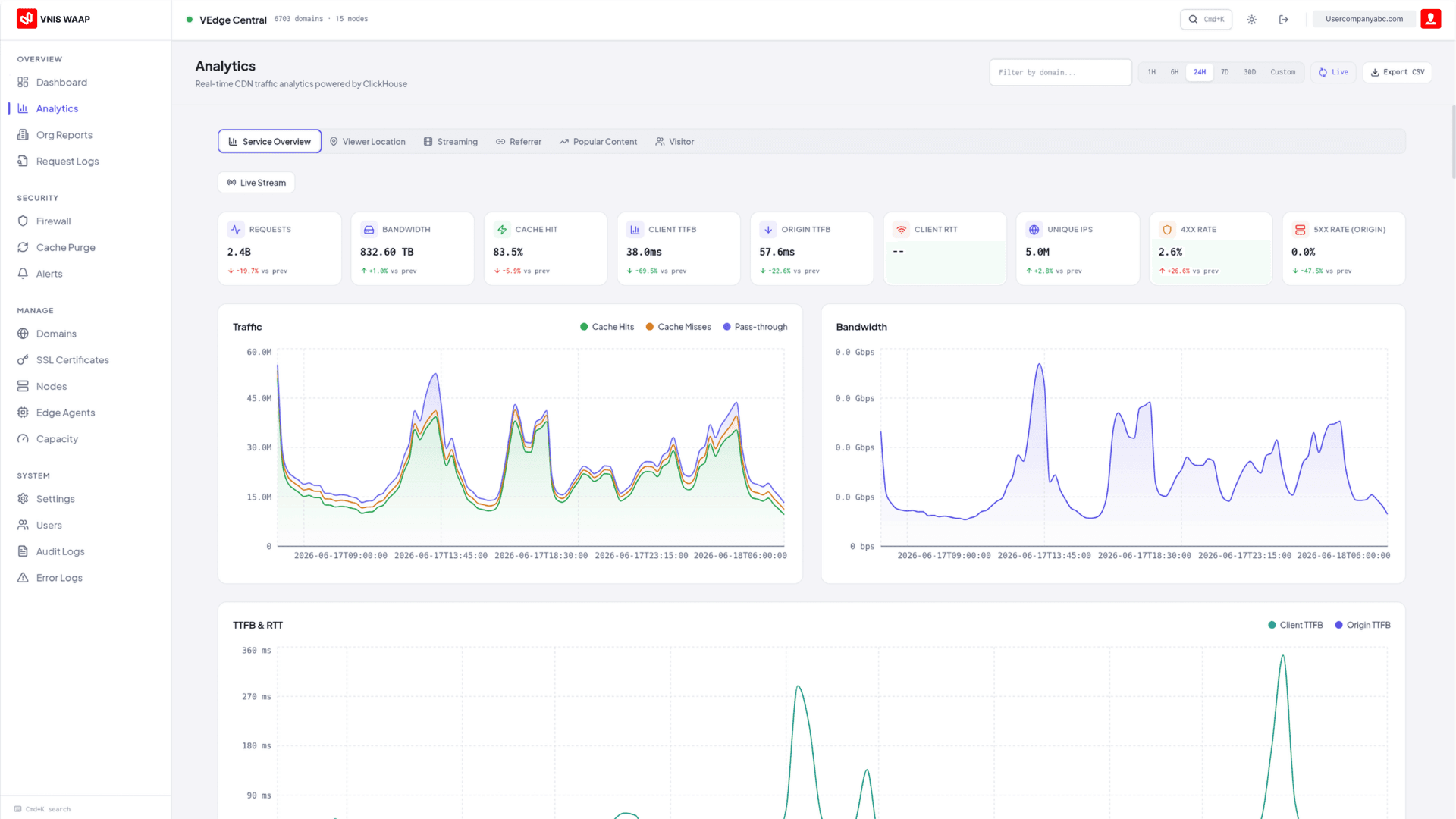
In terms of infrastructure, VNETWORK WAF Free runs entirely on servers located in Vietnam. This gives a clear advantage to businesses whose user base is concentrated domestically, minimizing transmission latency, ensuring fast access speeds, and keeping user connections stable.
Built by a Vietnamese technical team, the solution has deep insight into the local cybersecurity landscape and the real needs of domestic businesses. Businesses get direct technical support in Vietnamese around the clock, instead of relying on English language documentation or community forums like many international solutions require. Choosing a local solution is the safest, fastest, and most suitable choice for a Vietnamese business.
If your website or web application still lacks application layer protection, this is a good time to start with WAF Free, a free, easy to integrate solution ready to support your business from day one.
Button;Try now;https://partner.vnetwork.vn/?utm_source=google&utm_medium=blog&utm_campaign=waf_free&utm_term=wafvsfirewall;_blank
No. WAF only protects the application layer and cannot control access at the network layer the way a traditional firewall does. Businesses need to deploy both to ensure comprehensive security.
Yes. Network firewall is the full technical name for a traditional firewall, used to clearly distinguish it from WAF in comparison articles. Both terms refer to the same solution, operating at Layer 3 and Layer 4 of the OSI model.
Cloud based WAF is usually more cost effective in the early stages since it runs on an OPEX model and does not require the large hardware investment a traditional firewall does. However, these are two investments serving two different security purposes, so a business should not choose one over the other based on cost alone.
A well designed WAF solution, combined with CDN infrastructure, will not noticeably affect page load speed. Some modern WAF solutions can even improve performance by filtering malicious traffic before it reaches the origin server.
A business can start by assessing its website's current vulnerabilities, then choose a WAF solution that matches its traffic scale and budget, prioritizing solutions with a free tier or trial, such as WAF Free, to validate effectiveness before committing to a full scale investment.