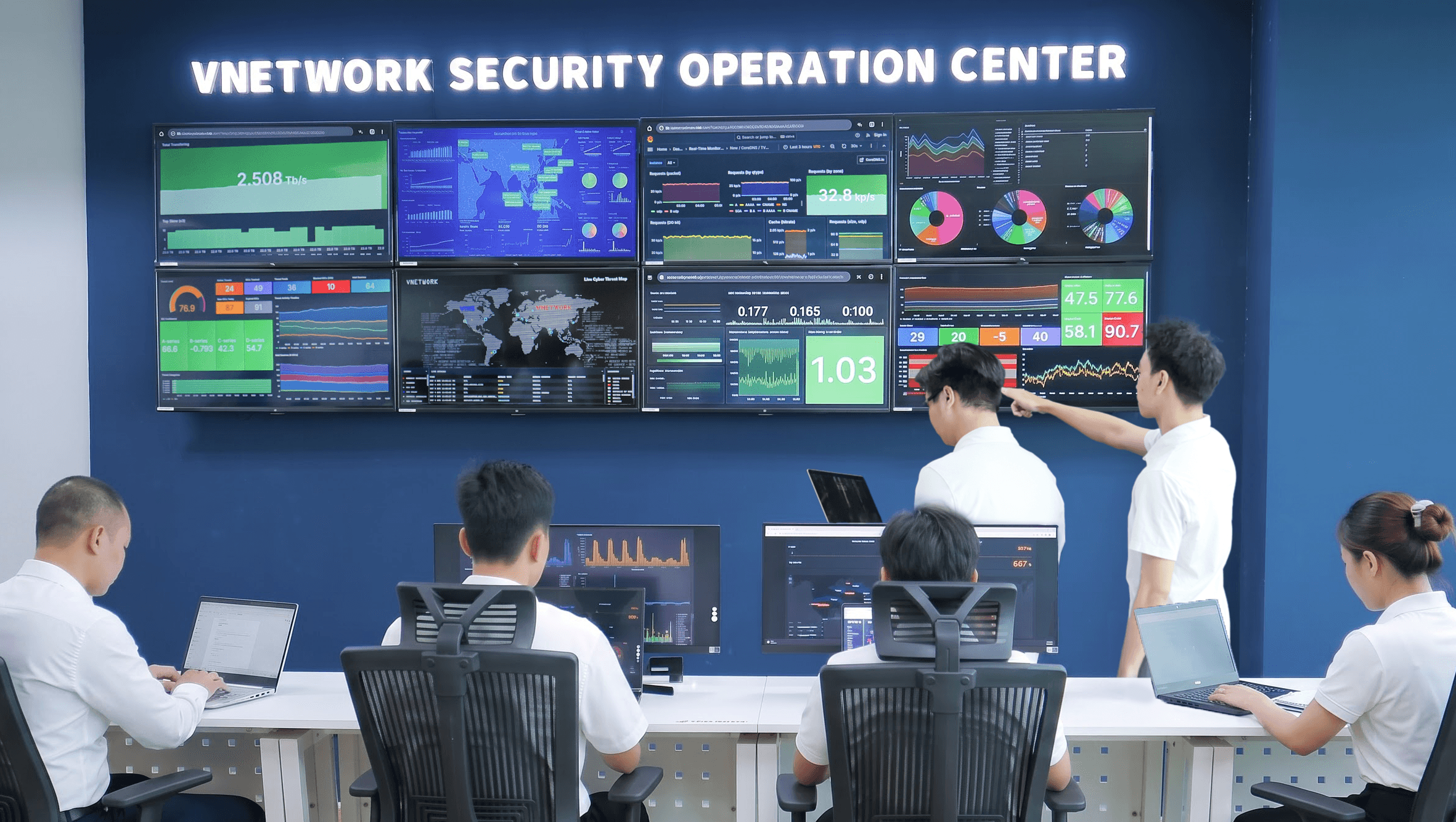
Founded in 2013 with the goal of building a safe cyberspace, VNETWORK now owns a comprehensive ecosystem spanning IT infrastructure, data transmission, and cybersecurity. We affirm our strength through more than 2,300 points of presence across 146 countries, along with a team of experts operating 24/7 Security Operations Centers (SOC) in Singapore, the United Kingdom, Taiwan (China), and Vietnam.
Fifteen years ago, many Vietnamese businesses found themselves on the defensive against cyberattacks, suffering heavy losses to both their systems and data, yet still accepted this risk as inevitable. At that time, domestic solutions weren’t yet trusted enough, while expensive foreign solutions turned security into "a privilege for the wealthy." The fact that information and data safety depended entirely on foreign providers left me deeply concerned about national digital sovereignty.
I entered the security industry not to chase a market opportunity or to prove myself as a woman in the field, but because I recognized it as an urgent survival issue for businesses. Once I made that choice, I committed to seeing it through to the end.
Information security in Vietnam today presents two contrasting pictures. Large corporations treat security as a prerequisite for operations, while small and medium enterprises (SMEs) still see it as an expense that can easily be cut.
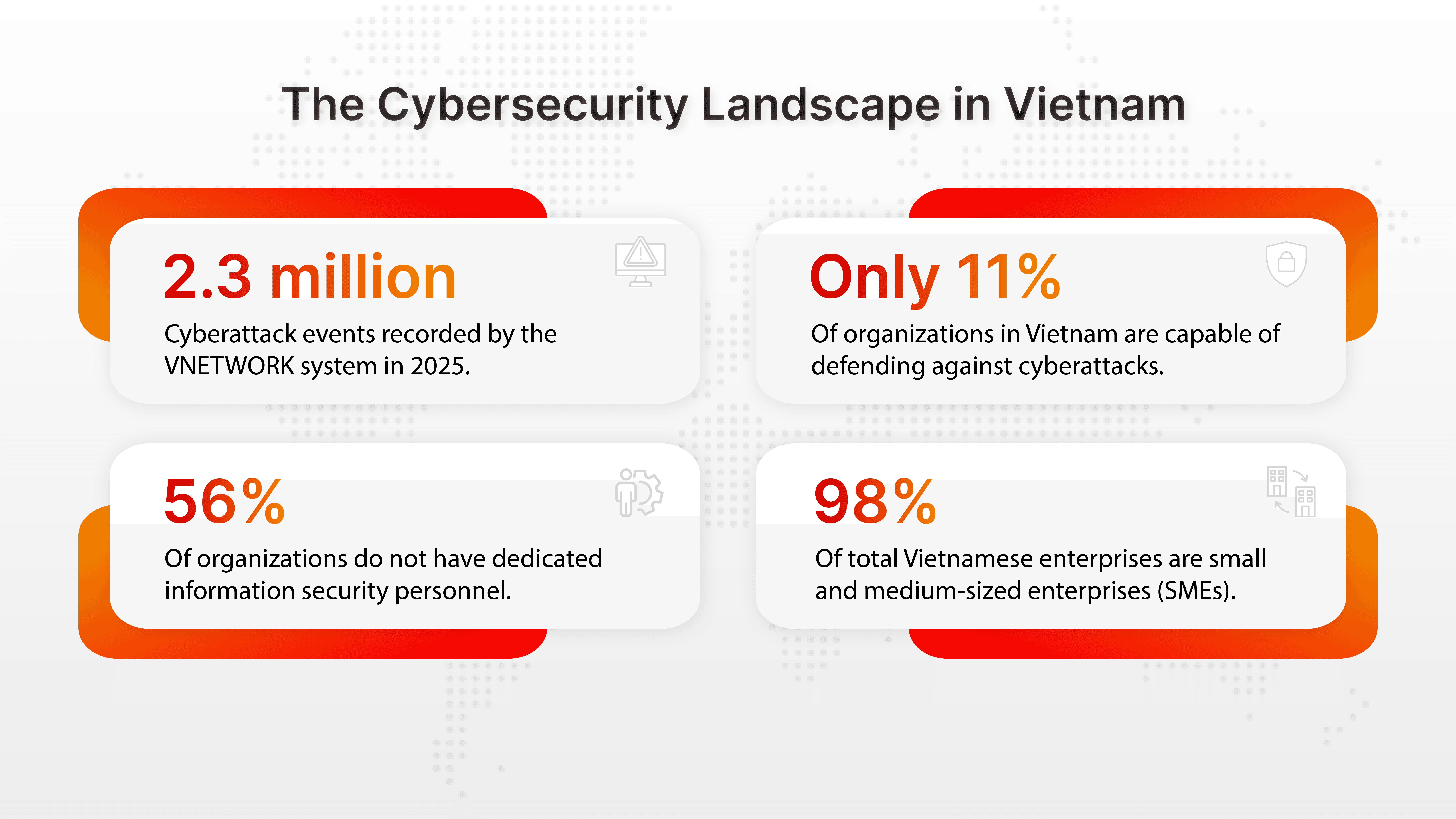
In reality, cybersecurity pressure is climbing to record levels: VNETWORK’s systems recorded as many as 2.3 million attack events in 2025. As AI drives down costs and automates intrusion techniques, businesses are pushed into an even more dangerous position. Alarmingly, only 11% of organizations in Vietnam currently have the capability to respond to incidents, and more than half (56%) have no dedicated security personnel.
In the digital era, the notion that SMEs stand outside the security game is a dangerous misconception. The digital economy operates as an interconnected value chain: a small logistics company or a fintech startup can hold data or connect directly into the systems of major corporations and banks. If just one link breaks, the whole system suffers the consequences. SMEs account for 98% of all businesses in Vietnam, and if they remain the weakest link in information security, the risk to the entire economy is enormous.
Our legal framework has, in fact, already set out very specific requirements. Under Decree No. 85/2016/ND-CP (Clause 2, Article 8) and Circular No. 12/2022/TT-BTTTT, information systems classified at Level 2 that fall under the regulation, as well as those at Level 3 and above, are required to deploy a web application firewall (WAF). In addition, the Personal Data Protection Law, taking effect in 2026, will require every organization that processes data to apply technical measures against data leaks.
Compliance with information security is no longer optional; it is now a mandatory obligation. Yet cost and staffing constraints are turning this minimum standard into a luxury for hundreds of thousands of businesses.
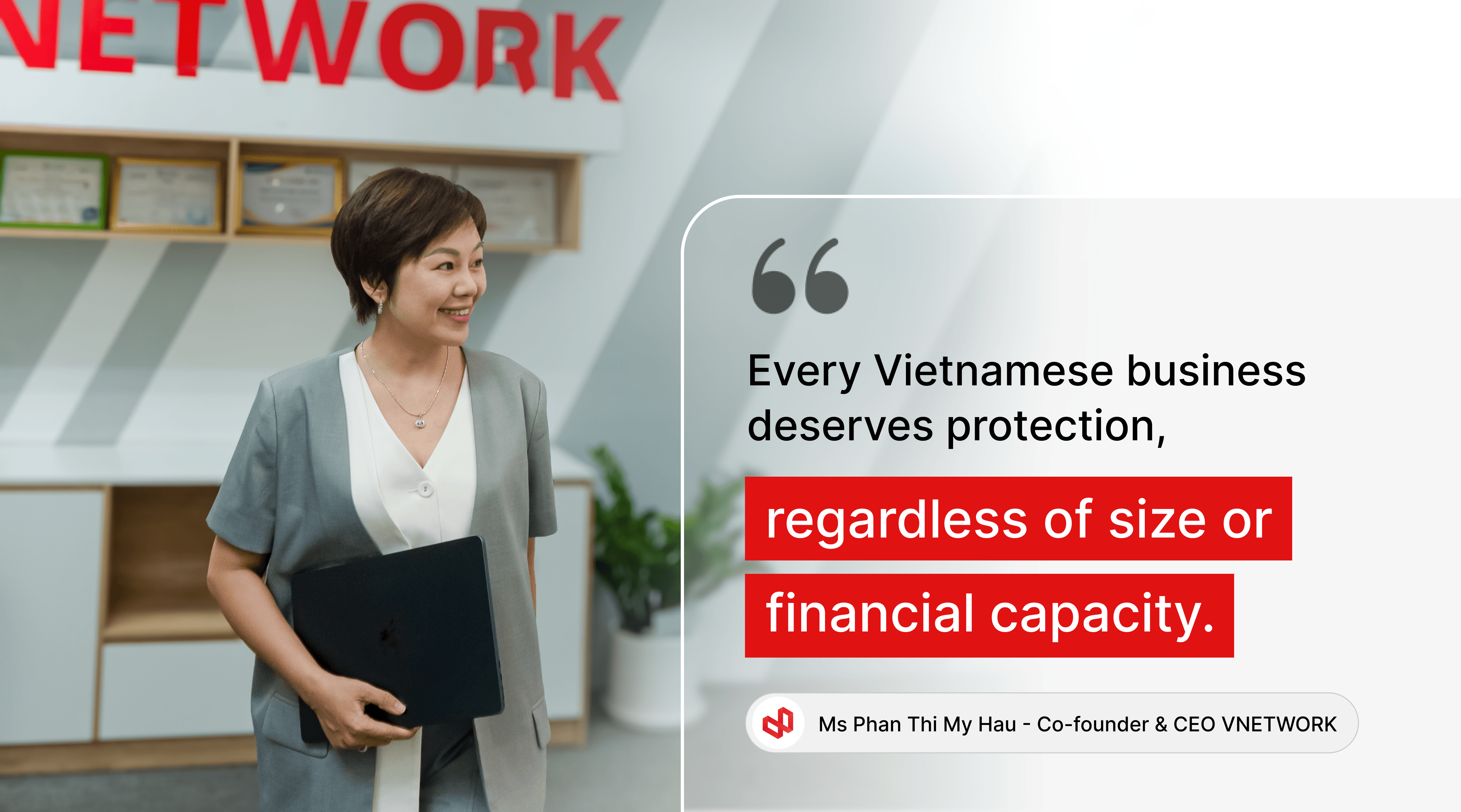
We believe every Vietnamese business has the right to be protected, regardless of its size or financial capacity. This is our responsibility to do what’s right for the community. When hundreds of thousands of businesses are digitizing rapidly while security fails to keep pace, a single incident can quickly spread into a risk for the entire national digital ecosystem. We refuse to stand on the sidelines.
Exactly. We wanted to remove the financial and operational barriers standing in the way of our mission to "democratize" information security.
Notably, this WAF Free version is by no means a feature-stripped trial. We have packaged the full defensive capabilities built for large corporations into a streamlined solution, allowing any business to set up a solid protective barrier in just minutes, entirely free of charge.
The key lies in combining 13 years of accumulated experience with the power of AI. We trained specialized AI models on VNETWORK’s massive real-world attack data to automate the fine-tuning of millions of security rules, removing complex technical barriers for the user entirely.
Packaging a solution originally built for large entreprises into an ultra-streamlined version that runs smoothly, after just six months of accelerated development, was truly a remarkable achievement by VNETWORK’s Research and Development (R&D) team.
Picture this solution as a guard standing right at the entrance of a website, checking every visitor and blocking suspicious behavior from automated bots before they can cause harm. WAF Free protects websites against attacks that exploit dangerous vulnerabilities listed in the OWASP Top 10 (SQL Injection, XSS, RFI, and more), integrates basic DDoS protection, accelerates delivery through a content delivery network (CDN), and provides a real-time traffic monitoring dashboard.
The solution inherits its core security technology from VNIS, the platform currently protecting more than 400,000 websites, apps, and APIs for leading media outlets, entertainment platforms, and financial and insurance institutions in Vietnam. Non-technical users can activate it themselves in just 3 simple steps in about 2 minutes, without changing their existing IT architecture. To me, a business shouldn’t need deep technical expertise to earn the right to be protected. That is the true meaning of the word "free."
It’s true that this decision will inevitably reduce a portion of VNETWORK’s short-term revenue. But I want to be clear: WAF Free is not a short-term "bait." Businesses can use it indefinitely with no pressure to upgrade. This is a standard global freemium model: we choose to invest in our customers’ growth. As their traffic scales up and their security needs become more complex, customers will voluntarily move to a paid plan because they have already placed their full trust in the platform. That is the path to sustainable returns.
In the long run, once millions of Vietnamese businesses are properly protected, the entire national digital ecosystem becomes safer. In the cybersecurity industry, trust is the most valuable asset, and it cannot be bought with money. That is the greatest value we are investing in.
If our security infrastructure were entirely in the hands of foreign corporations, we would be left powerless in the event of a geopolitical incident or a submarine cable disruption. The decision to "democratize" WAF is a concrete action reflecting this spirit: using Vietnamese technology, owned and controlled by Vietnamese people, to protect the digital assets of Vietnamese people.
Our ultimate goal is the ability to predict and stop threats before they happen, shifting from passive defense to proactive defense. Because the best security system is the one users never have to think about, since every risk has already been addressed in advance.
In a market where most business decisions are weighed on the scale of revenue, our choice to "give" can be seen as swimming against the current, yet it is a long-term calculation that is entirely worthwhile: joining hands to build a Vietnamese cyberspace that is safe, sustainable, and self-reliant, powered by the capability, technology, and resolve of the Vietnamese people.
This article was originally published on CafeBiz, read the original article here.