
CDN for fintech: a solution for accelerating and securing financial services
Over the past few years, the fintech (Financial Technology) market in Vietnam has grown rapidly, encompassing services such as e-wallets, digital banking, investment applications, and online payments. Users have grown accustomed to transferring money, making payments, or investing in just a matter of seconds.
However, behind this convenience lies a significant technology challenge: how can financial websites and applications remain fast, stable, and completely secure? This is precisely why many fintech businesses are beginning to deploy CDN for fintech to optimize performance and protect their systems.

What is a CDN and why does fintech need one?
CDN (Content Delivery Network) is a system of multiple servers located at different geographical positions. When a user accesses a website or application, content is loaded from the server nearest to them rather than solely from the origin server.
A simple way to picture this:
- If a website has only one server in Hanoi, users in Ho Chi Minh City must go through a longer transmission path, resulting in slower speeds.
- With multiple CDN servers distributed across different locations, the system automatically routes requests to the nearest server, significantly reducing load time.
In the fintech industry, this matters enormously because every second has a direct impact on financial transactions. CDN not only helps accelerate access but also ensures that fintech systems remain stable as user volumes grow. It serves as a critical infrastructure foundation that allows digital financial services to maintain fast, smooth, and reliable experiences for their users.
Key challenges facing fintech applications today
The rapid growth of digital financial services has placed fintech platforms under increasing pressure on their technology infrastructure. From transaction processing speed and load capacity to data security, every factor directly affects user experience and system reliability.
1. Transaction processing speed must be extremely fast
In digital finance, users expect every action within an application to happen almost instantly. Activities such as e-wallet transfers, QR code payments, and stock trading typically complete within seconds, so any delay can make users feel the system is malfunctioning.
Even a 1 to 2 second slowdown in the website or application can cause users to:
- Assume the transaction has failed and attempt the same action multiple times
- Switch to a competing platform altogether
This not only disrupts the user experience but can also increase the risk of transaction errors. Therefore, accelerating a fintech application is not simply a technical matter; it has a direct impact on revenue and brand credibility. A fast and stable processing system ensures smooth transactions, builds user trust, and supports long-term customer retention.
2. Sudden traffic spikes
Another common challenge for fintech platforms is sudden traffic surges over short periods, particularly when large numbers of users access and transact simultaneously. Platforms typically face:
- Sharp traffic increases during peak hours: During high-usage periods such as morning or end-of-day sessions, the number of users logging in and making transactions simultaneously can spike rapidly.
- High transaction volumes during promotional campaigns: Cashback programs, payment incentives, or fee reduction offers typically attract a large influx of users within the same time window.
- Volatile financial market events: When the stock market, cryptocurrency markets, or other investment channels experience significant movement, users tend to access the platform continuously to monitor and execute trades immediately.
If the system infrastructure is not robust enough to handle large concurrent volumes, the website or application may experience slow loading, overloading, or even downtime. CDN for financial applications helps distribute traffic across multiple servers, relieving pressure on the origin server and keeping the system stable even when user numbers surge unexpectedly.
3. User data security
Alongside speed and load capacity, user data security is a particularly critical requirement for fintech platforms. A single vulnerability can lead to a financial data breach or cause serious damage to a business's reputation.
Fintech platforms process highly sensitive data including account information, transaction histories, and personal data. As a result, CDN security for fintech needs to integrate technologies that reduce the risk of data leakage or system attacks, such as:
- SSL/TLS (data encryption): This technology encrypts data in transit between users and servers, preventing interception or unauthorized reading of information during transactions.
- Origin IP masking: Concealing the IP address of the origin server reduces the risk of direct attacks by malicious actors and adds an additional layer of protection for the system infrastructure.
- Access control: The system can establish access control rules to allow only legitimate sources, thereby minimizing unauthorized access attempts.
- Protection against cyberattacks: Security mechanisms help detect and block common attack types such as DDoS attacks and malicious bots, ensuring the fintech system continues to operate reliably.
To meet these stringent requirements, fintech platforms need infrastructure that is simultaneously fast, stable, and secure. This is why many financial businesses are turning to CDN as an optimal solution for both performance and system protection.
How does CDN for banking and financial services work?
To ensure financial applications are always fast and accessible, many businesses deploy CDN as an infrastructure layer that supports content distribution. When integrated into a banking or fintech system, CDN optimizes data transmission pathways and reduces load on the origin server.
CDN for banking and financial services typically operates on the following principles:
- Website or application content is cached across multiple CDN servers: Static assets such as images, interface files, and frequently accessed content are replicated across servers at various geographical locations, ready to serve users on demand.
- Users are routed to the nearest server: When a user opens the website or application, the CDN system automatically routes the request to the server closest to their location, shortening the data transmission distance.
- Content loads faster and reduces load on the origin server: By distributing data delivery from multiple points, the origin server is not required to handle all traffic, enabling the system to operate more reliably.
A useful way to picture CDN is as a network of distribution warehouses for a logistics company. If a business operates only one central warehouse, deliveries to distant customers take considerably longer. When warehouses are positioned closer to customers, deliveries become faster and more efficient.
CDN operates in exactly the same way, except instead of physical goods it distributes internet data from multiple servers. This allows banking platforms and financial services to ensure fast access speeds, a stable experience, and better service for their users.
Benefits of deploying CDN for fintech applications
Deploying CDN is becoming an increasingly common practice in digital finance. Beyond accelerating access, CDN helps fintech platforms operate more reliably and securely in environments with high transaction volumes.
- Faster website and application loading: CDN shortens data transmission distances by delivering content from servers closest to users, reducing latency, improving page load speed, and enhancing the overall experience. This is especially significant for financial platforms such as e-wallets, mobile banking, and investment apps, where response speed directly influences user experience and transaction outcomes.
- Greater capacity to handle concurrent users: CDN distributes traffic across multiple servers worldwide, helping the system avoid overloading when user numbers spike. This keeps the service stable and capable of serving millions of users simultaneously, especially during peak periods such as promotions or market volatility.
- Protection against network security risks: CDN for financial services typically integrates multiple security layers including data encryption, origin IP masking, and filtering of anomalous traffic. These protections reduce the risk of cyberattacks and safeguard both the fintech infrastructure and user transaction data.
- Optimized content rendering: CDN supports data compression, image optimization, and conversion to modern formats such as WebP to reduce download size. As a result, websites continue to look sharp and clear while loading faster, improving overall platform performance.
Thanks to these benefits, CDN is increasingly becoming an essential component of the technology infrastructure for banks and fintech applications, enabling systems to perform faster, operate more stably, and deliver a consistently good experience for users.
VNCDN: a CDN solution for fintech from VNETWORK
Domestic CDN helps fintech platforms optimize access speed for users in Vietnam. When a website or application uses a CDN with servers hosted at domestic internet service providers (ISPs) and regional networks, data is distributed from servers closer to users, significantly reducing access latency and improving load speed. This makes domestic CDN solutions like VNCDN particularly well suited to fintech businesses primarily serving customers within the country.
VNCDN is a CDN solution developed by VNETWORK that helps businesses accelerate websites and applications while protecting systems from network security risks. After more than 12 years of development, VNCDN has partnered with 500+ clients and accelerated 1,000+ websites and applications across industries including e-commerce, media, OTT, and fintech. Many financial platforms have deployed VNETWORK's CDN infrastructure, including MoMo, VPS Securities, FireAnt, Trusting Social, Galaxy Pay, One Mount, and FinFan, to improve web and app access speed and enhance the user experience.
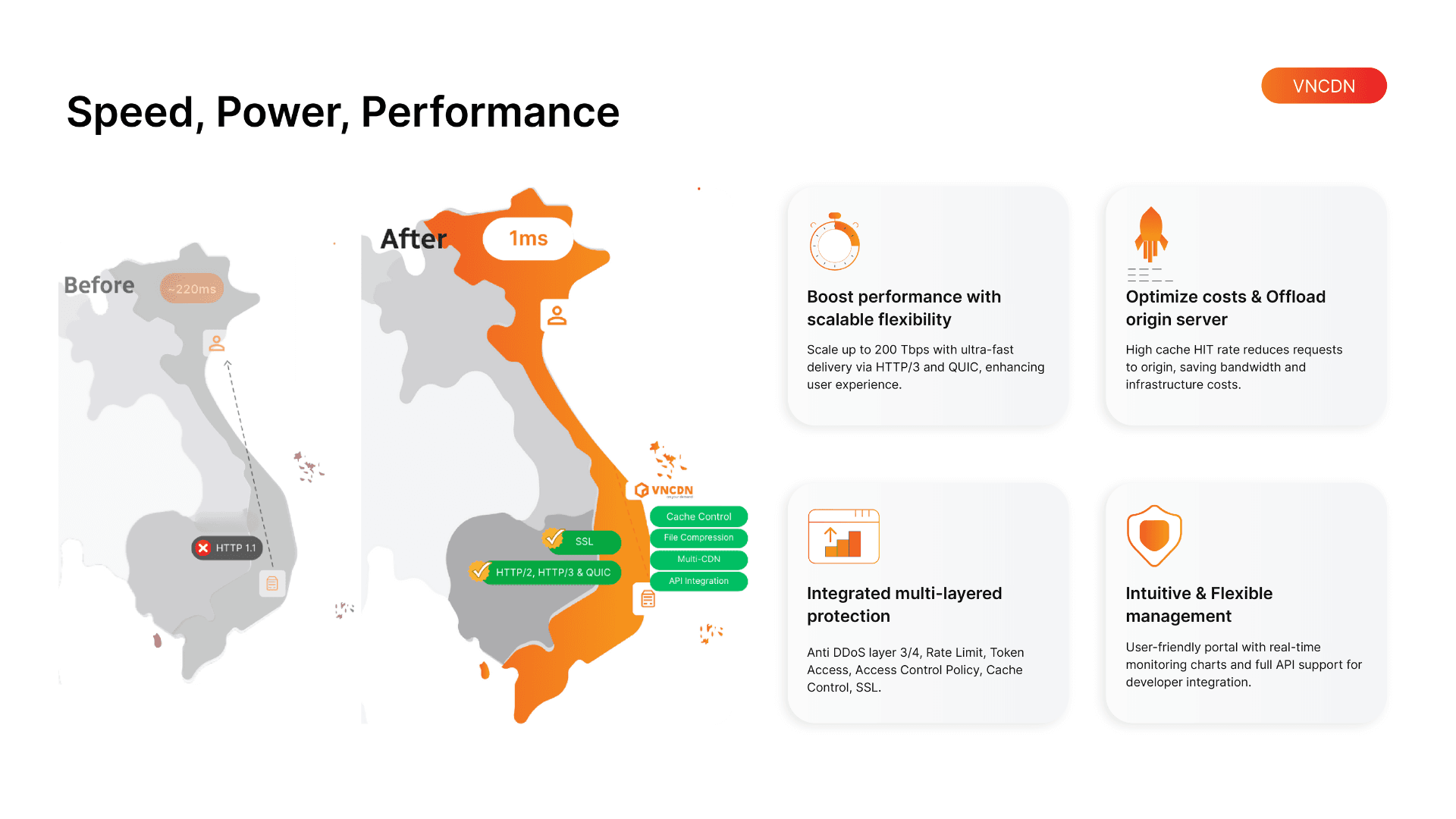
To meet the growing demands for acceleration, infrastructure scaling, and system security, many businesses choose to deploy CDN based on the following key advantages:
- Global-scale CDN infrastructure: VNETWORK has built VNCDN on a large infrastructure comprising 2,300+ PoPs across 146+ countries and 200+ Tbps of international uplink bandwidth. This scale enables faster data distribution, reduced access latency, and flexible scalability as user volumes grow.
- Advanced CDN technology: VNCDN integrates a range of performance-enhancing technologies including HTTP/3 and QUIC for fast and stable data transmission, Origin Shield to reduce load on the origin server, and NVMe/SSD storage for accelerated data retrieval. The system also supports flexible API integration, enabling financial applications to operate reliably even during sudden traffic spikes.
- Integrated security ecosystem: VNCDN can be combined with VNETWORK's security solutions including WAF (Web Application Firewall), Anti-DDoS, and the SOC system for 24/7 monitoring. This allows fintech businesses to simultaneously optimize access performance and strengthen system protection against network risks.
- Suitable for diverse business models: Beyond fintech, VNCDN is also deployed by businesses across e-commerce, OTT video, livestreaming, online news, and gaming. CDN infrastructure enables these platforms to accelerate websites and apps, serve large user bases, and improve the overall access experience.
Thanks to its large-scale infrastructure, advanced CDN technology, and comprehensive security ecosystem, VNCDN from VNETWORK helps businesses optimize system performance, improve user experience, and maintain stable operations even as traffic volumes increase.
For a deeper look at CDN technology in video streaming, see: What is HLS? Dedicated CDN HTTP Live Streaming for OTT video, or explore Top 5 low latency streaming solutions for digital businesses.
Conclusion
In the fintech industry, access speed and data security are two decisive factors that determine both user experience and brand credibility. Even minor system slowdowns or security incidents can directly erode customer trust.
Deploying CDN for fintech therefore does more than just accelerate websites and applications; it also reduces the load on server infrastructure and provides stronger protection for customer data. Through intelligent content distribution and multi-layered security integration, CDN helps financial platforms maintain stable operations even under high traffic loads.
With robust infrastructure and advanced CDN technology, VNCDN from VNETWORK is becoming the preferred choice for many fintech businesses. The solution accelerates applications, raises security standards, and supports businesses in scaling their user base reliably within an increasingly competitive digital financial market.
FAQ: Frequently asked questions about CDN for fintech
1. What is CDN for fintech?
CDN for fintech is a distributed server system that accelerates access to financial websites and applications. When users access the platform, data is loaded from the nearest server, reducing latency, improving the experience, and reducing load on the origin server.
2. Why do financial applications need a CDN?
Financial applications require fast and stable transaction processing. CDN improves page load speed, distributes traffic load, and protects systems against network security risks, ensuring a smoother user experience.
3. Does CDN help improve security for financial services?
Yes. CDN typically integrates multiple security layers including SSL/TLS encryption, origin IP masking, and access control. These features help reduce the risk of cyberattacks and better protect user data.
4. What advantage does a domestic CDN offer for fintech businesses in Vietnam?
A CDN with servers hosted at domestic ISPs reduces data transmission distances, lowering access latency and improving page load speed. This is especially effective for platforms where the majority of users are located in Vietnam.
5. Is VNCDN suitable for fintech startups?
Yes. VNCDN supports flexible scaling based on demand, easy API integration, and a technical support team available 24/7. This allows fintech startups to rapidly deploy their transmission infrastructure and focus on building their core product.