
VOD (Video on Demand) is a system that allows users to select and watch video content at any time, independent of fixed broadcast schedules like traditional television.
Simply put, VOD is like watching YouTube or an online streaming platform: you choose what to watch, and you can pause, rewind, or replay at any time.
The key characteristics of VOD include: content selection on demand, multi-device access across smartphones, computers, and TVs, playback controls (pause, rewind, replay), and complete independence from broadcast schedules.
Once you understand what VOD is, you can see how this technology is applied across various platforms, offering users a more flexible viewing experience.
In cable television, videos are stored on servers and users can select content to watch through a set-top box. Viewers can pause, rewind, or resume content as needed.
However, this approach still depends on traditional infrastructure and content is typically only available for a limited time.
This is the most common form today, allowing users to watch videos anytime, anywhere, on multiple devices with just an Internet connection.
Thanks to strong scalability and diverse content, Internet-based VOD is fast becoming the dominant trend in the video industry. For example, platforms from Microsoft Corporation and Sony Corporation have integrated VOD on Xbox and PlayStation.
Compared to the two forms above, satellite television is not true VOD because it broadcasts content to all viewers simultaneously and does not allow users to choose when to watch.
In summary, VOD is evolving toward greater flexibility and convenience, with Internet-based VOD being the most popular and effective form available today.
A basic VOD system consists of: a video storage server (where original content is held), a CDN (Content Delivery Network, which brings video closer to the viewer), and a video player to display the content. The system may also integrate transcoding (video encoding conversion), a CMS (content management system), and security layers to optimize performance and protect data.
For a video to play smoothly after a single click, there is an optimized processing and delivery pipeline working behind the scenes, ensuring content reaches viewers quickly, reliably, and in a format suited to their device:
When a user selects a piece of content, the system retrieves the video from the central storage server or from pre-processed versions prepared through transcoding. These versions are typically optimized for format, resolution, and file size, reducing processing time and making them ready for immediate delivery. As a result, the video can be dispatched almost instantly once the user hits play.
Once the data is retrieved, the video is not sent directly from the origin server. Instead, it travels through the CDN (Content Delivery Network). The CDN automatically selects the server closest to the viewer's location to transmit the data. This shortens the transmission distance, reducing latency, improving load speeds, and minimizing buffering, especially when many viewers are watching simultaneously.
When data arrives at the user's device, the video player receives it and automatically adjusts quality to match the screen and Internet speed. For example, if the connection is slow, the resolution drops to ensure continuous playback; if the connection is strong, quality is boosted. This gives viewers a consistently smooth experience without any manual adjustments.
Thanks to this process, VOD can serve a large number of simultaneous viewers while maintaining stable performance. You can think of it like online shopping: the system always picks the nearest warehouse to deliver faster, rather than shipping from a distant location.
In summary, the entire VOD pipeline is optimized at every stage, from storage and delivery to playback, ensuring content reaches users quickly, smoothly, and without interruption.
To deploy VOD (Video on Demand) effectively, businesses need to choose a platform with all the necessary features. These features not only ensure smooth playback but also support content management, copyright protection, and user experience optimization.
A VOD system is only truly effective when it is fully equipped with features spanning video processing, security, and data analytics. This is the foundation that enables businesses to ensure delivery quality and sustainably improve the user experience.
The rise of the Internet has dramatically changed how users access content. VOD is increasingly becoming a direct competitor to traditional television, thanks to its flexibility and superior experience.
VOD platforms offer rich content libraries spanning entertainment, education, news, training, and more, meeting the increasingly diverse needs of users. Beyond sheer volume, VOD elevates the experience through personalization: the system can recommend videos based on individual behavior and preferences. This helps users discover relevant content quickly, without lengthy searches, creating a more convenient and efficient experience than traditional television.
With its advantages in flexibility, content diversity, and personalization, Internet-based VOD is steadily gaining the upper hand and becoming the trend that is replacing traditional television in the digital age.
Live streaming is the broadcast of video in real time, suited to events, live programs, or online sales. VOD, by contrast, consists of pre-recorded videos that users can watch back at any time.
Example: Live streaming is like watching a football match as it happens; VOD is like rewatching the game when you have free time.
The table below summarizes the key differences between Live Streaming and Video on Demand.
| No. | Criteria | Live Streaming | Video on Demand (VOD) |
|---|---|---|---|
| 1 | Broadcast time | In real time | Watch at any time |
| 2 | Content status | Incomplete, ongoing | Pre-produced and finalized |
| 3 | Replay availability | Limited (unless saved) | Easy replay, no time limit |
| 4 | Interactivity | High (comments, reactions, live Q&A) | Lower; primarily passive viewing |
| 5 | Common use cases | Events, live sales, webinars | Films, entertainment programs, online courses |
| 6 | Technical requirements | Continuous data processing, low latency | Optimized storage and content delivery |
| 7 | User experience | "Simultaneous" feel, live participation | Flexible, self-directed viewing time |
In summary, both live streaming and VOD have their own strengths and suit different purposes. Where live streaming delivers real-time interactive engagement, VOD stands out for its flexibility and ability to be replayed at any time. Businesses can combine both formats to maximize audience reach and user experience.
It is no coincidence that VOD (Video on Demand) is growing in popularity among both users and businesses. Its appeal lies in meeting the demand for flexibility, personalized experience, and operational efficiency in the digital age.
By combining flexibility, personalized experience, and cost optimization, VOD is not only appealing to users but has also become an important tool for businesses to boost communication effectiveness and drive growth in the digital environment.
For VOD (Video on Demand) to deliver results, businesses need to deploy content strategically rather than publishing isolated videos. Combining the right type of content, the right touchpoints, and data-driven insights will improve both attraction and conversion.
Combining well-crafted content, effective distribution, and smart use of data will help businesses fully leverage the power of VOD. This is the essential foundation for attracting customers and improving marketing effectiveness in the digital environment.
A VOD service is a solution that helps businesses build and operate a professional on-demand video system. Through this platform, businesses can store and manage video content centrally, while automatically converting formats to suit different devices and network speeds. Video is also delivered to users quickly and reliably, supported by viewer behavior tracking and analytics to optimize content and communication effectiveness.
In practice, VOD services are widely used across many sectors. Businesses can deploy online streaming platforms, build e-learning systems, use video in marketing campaigns, or create internal video libraries for training and knowledge sharing.
For example, a training organization can build a library of lecture videos for learners to access and study at any time, improving the learning experience and knowledge retention.
To deploy VOD effectively, businesses need a robust infrastructure platform. The VMS (Video Media Service) solution within VNCDN's ecosystem by VNETWORK meets all these requirements.
VMS (Video Media Service) within VNETWORK's VNCDN ecosystem is designed to comprehensively optimize the processes of video processing, delivery, and management. Beyond enabling rapid deployment, VMS also improves delivery quality and significantly reduces operational costs.
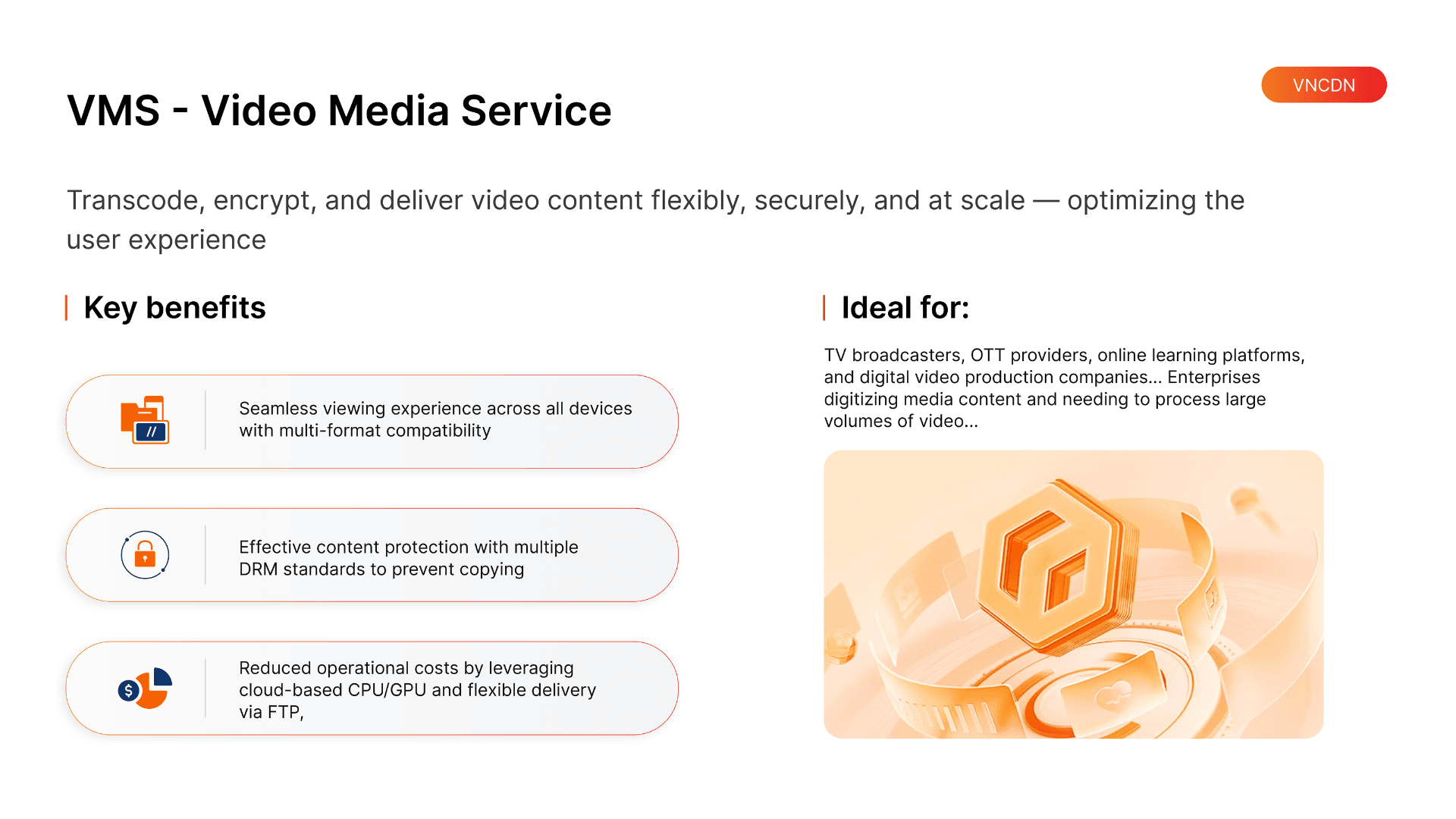
With these standout features, VMS not only makes VOD deployment straightforward but also ensures long-term performance, quality, and scalability.
VNETWORK's VMS is designed with a simple deployment process, enabling businesses to upload videos and distribute them to users quickly without complex procedures.
With a streamlined process requiring just a few steps, VMS helps businesses cut deployment time and bring video content to users at optimal quality.
VNETWORK's VNCDN solution has been deployed in practice across multiple major video platforms in Vietnam, including VTV Go, VieON, and FPT Play. The results demonstrate clear improvements in performance and user experience.
These real-world outcomes demonstrate that VNCDN not only meets the demands of large-scale video delivery but also helps businesses optimize costs and sustainably enhance the user experience.
VOD (Video on Demand) is more than an entertainment trend; it is an important tool for businesses to thrive in the digital environment. Investing in a professional VOD platform helps businesses improve user experience, optimize costs, and scale effectively.
VNETWORK's VNCDN solution is a worthy option for businesses looking to deploy a video-on-demand system in a structured and sustainable way.
VOD (Video on Demand) allows users to select and watch video at any time via the Internet. Unlike traditional television where viewers follow a fixed schedule, VOD gives users full control over when and what they watch, delivering a far more flexible experience.
A VOD service is a solution that enables businesses to store, manage, and distribute video to users. It encompasses functions such as video transcoding, content security, CDN-based delivery, and viewer behavior analytics to optimize business effectiveness.
Television VOD is a form of on-demand TV content consumption that replaces fixed broadcast schedules. Users can select programs, replay previously broadcast content, and control playback, including rewinding, pausing, and resuming at any time.
Live streaming broadcasts video in real time, while VOD consists of pre-recorded videos that users can watch back at any time. Live streaming suits live events; VOD suits long-form content such as films, online courses, or marketing videos.
Businesses should look for a platform with a strong CDN, support for multiple video formats, DRM security, and a data analytics system. Scalability and ease of integration are also critical to ensure the system operates reliably over the long term.