---
title: "WAF vs. WAAP: Which solution fits your business"
description: Compare WAF and WAAP to choose the right protection for your website, APIs, and web applications.
slug: waf-vs-waap
type: news
locale: en-US
author: Tony Dang
date: "2026-08-20T10:24:14.854Z"
lastmod: "2026-08-20T10:24:14.726Z"
thumbnail: "https://static.vncdn.vn/vnetwork.vn/pub/websites/uploads/1/92/waf_vs_waap_thumb.png"
sabo: As systems expand to include APIs and mobile applications, many businesses discover that their existing WAF layer no longer covers these new access points. This raises the question of whether to move to WAAP, a solution often described as the natural extension of WAF. The two concepts are easy to confuse since both belong to the application layer security category, yet their protection scope differs significantly. This article clarifies the definitions, core differences, and selection criteria between the two solutions.
---

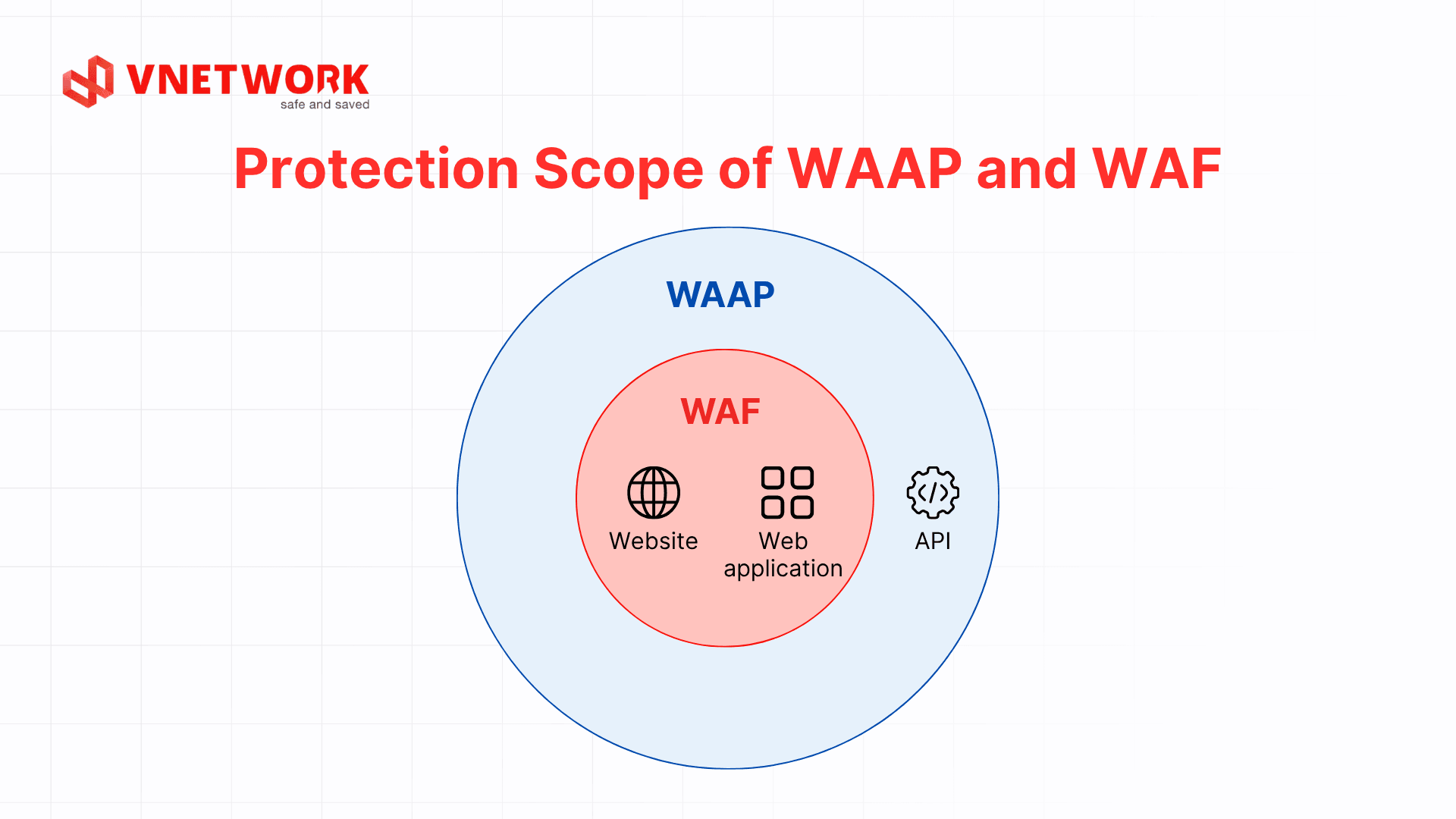
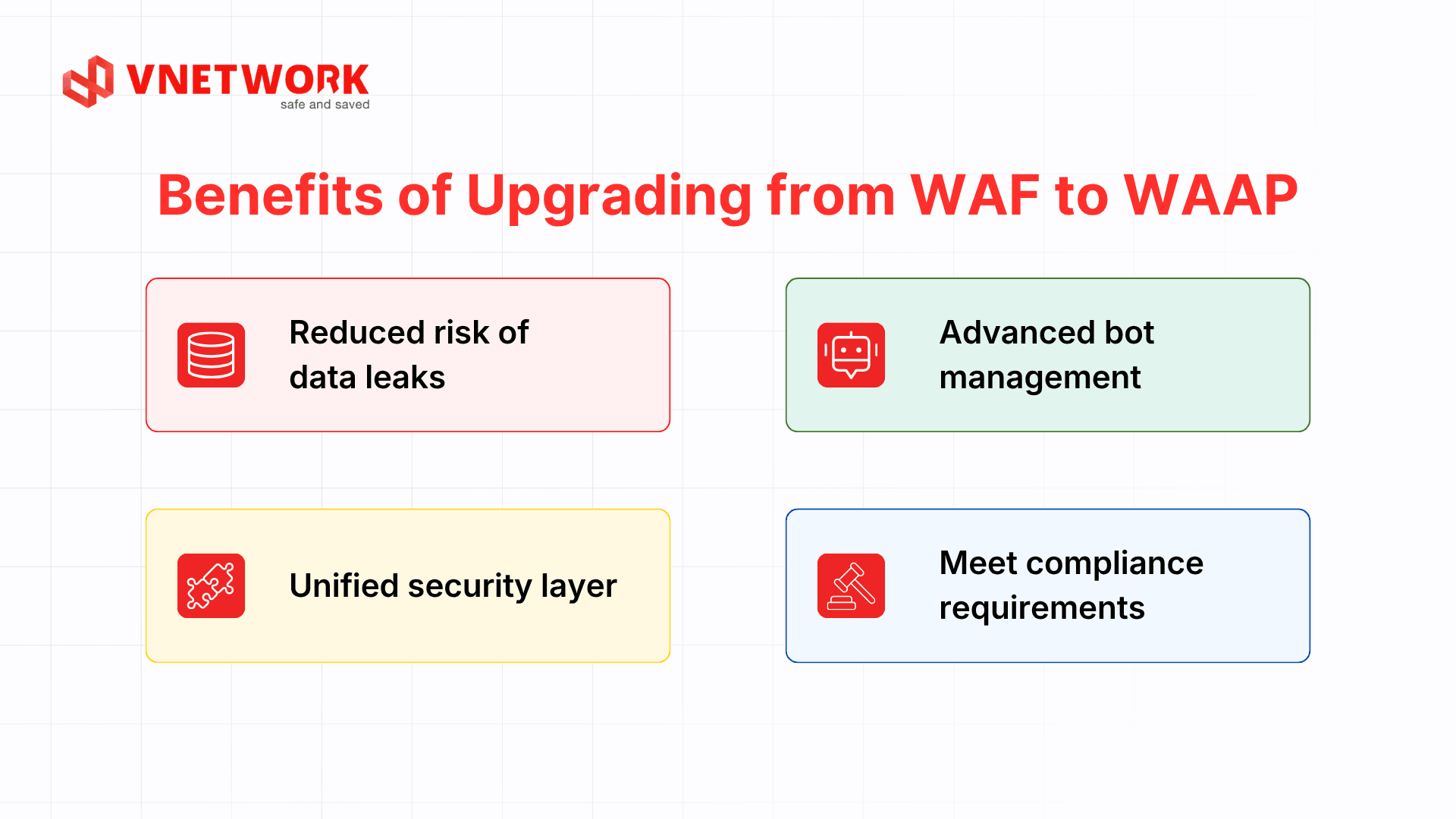
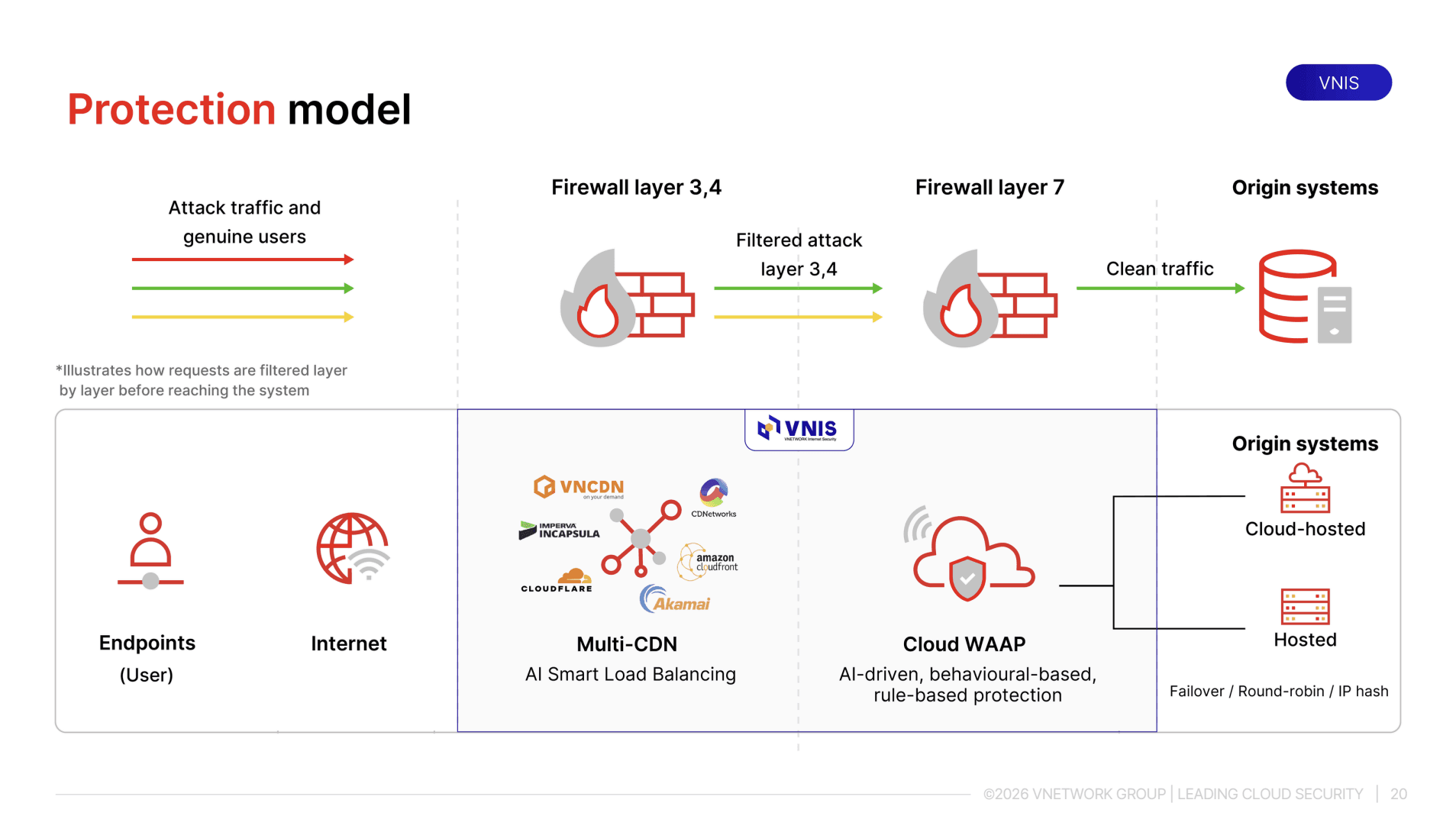
<h2><strong>1. What are WAF and WAAP?</strong></h2><p><a href="https://www.vnetwork.vn/en-US/news/waf-la-gi/"><strong>WAF</strong></a> (Web Application Firewall) is a security system operating at&nbsp;<a href="https://www.vnetwork.vn/en-US/news/layer-7-la-gi/">layer 7</a> of the OSI model, responsible for monitoring and filtering HTTP/HTTPS traffic entering a website or web application. WAF detects and blocks common attack types based on rule sets such as the&nbsp;<a href="https://www.vnetwork.vn/en-US/news/top-10-lo-hong-owasp-va-cach-bao-ve-webapp-2022/">OWASP Top 10</a>, including SQL injection, XSS, and vulnerabilities exploited through input forms or URLs. Unlike traditional network firewalls that control traffic at the network layer, WAF focuses on the application layer, where attacks target the website's processing logic directly.</p><p><strong>WAAP</strong> (Web Application and API Protection) extends WAF's protection scope to APIs and the endpoints that mobile applications and third party applications commonly call. In addition to the traffic filtering functions of WAF, WAAP integrates automated bot mitigation, access rate control, and anomaly detection based on pattern analysis rather than relying solely on a fixed rule set. WAAP suits systems built on microservices architecture, where many API endpoints are exposed publicly to serve mobile applications, integration partners, or third party services.</p><p>The difference between the two solutions is not about which one is better, but about the scope of the system each one is designed to protect. Businesses can also review the comparison between&nbsp;<a href="https://www.vnetwork.vn/en-US/news/waf-va-firewall-truyen-thong/">WAF and traditional firewalls</a> to better understand WAF's position within the overall security architecture before evaluating whether to expand to WAAP.</p><figure class="image"><img style="aspect-ratio:1920/1080;" src="https://static.vncdn.vn/vnetwork.vn/pub/websites/uploads/1/92/waf_vs_waap_1_en.png" alt="waf_vs_waap_1_en.png" width="1920" height="1080"><figcaption><i>Overview of WAAP and WAF</i></figcaption></figure><h2><strong>2. Key differences between WAF and WAAP</strong></h2><p>The following three criteria best reflect the differences between WAAP and WAF: protection scope, threat detection mechanism, and the ability to adapt to modern system architecture.</p><h3><strong>2.1. Protection scope</strong></h3><ul><li><strong>WAF:&nbsp;</strong>Focuses on protecting websites and web applications by filtering HTTP/HTTPS requests sent to the server. This scope suits systems that mainly serve users through a browser, with little to no public API.</li><li><strong>WAAP:&nbsp;</strong>Extends protection across the entire Web, App, and API ecosystem, including internal APIs called by mobile applications and public APIs serving integration partners. For systems with multiple types of access points, WAAP covers endpoints that a standalone WAF often misses.</li></ul><figure class="image"><img style="aspect-ratio:1920/1080;" src="https://static.vncdn.vn/vnetwork.vn/pub/websites/uploads/1/92/waf_vs_waap_2_en.png" alt="waf_vs_waap_2_en.png" width="1920" height="1080"><figcaption><i>Protection scope of WAAP and WAF</i></figcaption></figure><h3><strong>2.2. Threat detection mechanism</strong></h3><ul><li><strong>WAF:&nbsp;</strong>Operates mainly on a fixed rule set, similar to the OWASP Top 10 list, to identify known attack types. This rule based mechanism is effective against common threats but has limits against new attack behaviors or bots designed to mimic real user behavior.</li><li><strong>WAAP:&nbsp;</strong>Adds a behavior analysis based detection layer, combining&nbsp;<a href="https://www.vnetwork.vn/en-US/news/ai-waf/">AI WAF</a> to identify unusual patterns that static rule sets struggle to catch, while also integrating&nbsp;<a href="https://www.vnetwork.vn/en-US/news/botnet-la-gi-cach-phong-chong-ddos-botnet-check-botnet-2022/">botnet</a> management and&nbsp;<a href="https://www.vnetwork.vn/en-US/news/rate-limit-la-gi/">rate limit</a> control to restrict abnormal API requests.</li></ul><h3><strong>2.3. Adaptability to modern architecture</strong></h3><ul><li><strong>WAF:&nbsp;</strong>Designed for monolithic architecture, where most traffic passes through a single centralized web processing flow. For systems built on microservices architecture, often with dozens to hundreds of independently operating API endpoints, traditional WAF struggles to cover these distributed endpoints.</li><li><strong>WAAP:&nbsp;</strong>Designed to adapt to distributed architecture, allowing consistent security policies to be applied across many API endpoints without separate configuration for each service.</li></ul><h2><strong>3. Comparison table: WAF vs. WAAP</strong></h2><figure class="table" style="width:100%;"><table class="ck-table-resized"><colgroup><col style="width:25.43%;"><col style="width:38.45%;"><col style="width:36.12%;"></colgroup><tbody><tr><td><strong>Criteria</strong></td><td><strong>WAF</strong></td><td><strong>WAAP</strong></td></tr><tr><td>Protection scope</td><td>Website, web application</td><td>Web, App, and API</td></tr><tr><td>Detection mechanism</td><td>Rule based on rule sets (OWASP Top 10)</td><td>Rule based combined with behavior analysis, AI</td></tr><tr><td>Payload reading capability</td><td>Mainly checks URLs, headers, parameters; limited deep analysis of JSON/XML content</td><td>Reads and inspects the full content of requests and responses, validates JSON/XML structure</td></tr><tr><td>New attack detection</td><td>Relies on signatures, may miss attack techniques not seen before</td><td>Analyzes behavioral anomalies, can detect unusual signs even without a known attack sample</td></tr><tr><td>Bot mitigation</td><td>Basic, based on known patterns</td><td>Advanced, identifies bots that mimic real user behavior</td></tr><tr><td>Microservices and internal API coverage</td><td>Monitors traffic only at the edge, cannot see internal API calls between services</td><td>Broader coverage, can monitor traffic distributed across services</td></tr><tr><td>Suitable architecture</td><td>Monolithic systems with few public APIs</td><td>Microservices, many distributed API endpoints</td></tr><tr><td>Strength</td><td>Stable against classic web attacks, suitable for temporary patching when new vulnerabilities are found</td><td>Comprehensive protection for modern applications, APIs, bots, and cloud environments</td></tr><tr><td>Limitation</td><td>Lacks deep visibility into APIs, hard to detect business logic flaws</td><td>Cannot yet verify internal API logic or hidden endpoints, requires additional runtime testing</td></tr><tr><td>Best fit</td><td>Businesses newly deploying security, traffic mainly through browsers</td><td>Businesses with public APIs, mobile applications, integration partners</td></tr></tbody></table></figure><h2><strong>4. Why are businesses shifting from WAF to WAAP?</strong></h2><p>Businesses shift from WAF to WAAP mainly because their systems expand with APIs, mobile applications, and microservices architecture, components that traditional WAF cannot adequately cover.</p><p>Three main drivers push this shift: the growing number of public APIs serving mobile applications and integration partners, an increasingly sophisticated wave of bot attacks targeting APIs, and tightening security compliance requirements for data exchanged across multiple access points.</p><p>Specifically, the following factors are prompting businesses to reassess their existing protection layer:</p><ul><li><strong>System architecture changes:&nbsp;</strong>Businesses expanding into microservices, containerization, and API first models see a rapid increase in the number of endpoints, exceeding what a standalone WAF can monitor.</li><li><strong>Need for external integration:&nbsp;</strong>Mobile applications, third party partners, and open API models are becoming increasingly common, requiring a protection layer that understands API semantics rather than simply filtering ordinary HTTP requests.</li><li><strong>Increasingly sophisticated bot attacks:&nbsp;</strong>Automated bots can mimic real user behavior, easily bypassing the static rule based filters that WAF uses.</li><li><strong>Compliance pressure and modern security architecture:&nbsp;</strong>The trend toward adopting&nbsp;<a href="https://www.vnetwork.vn/en-US/news/zero-trust-la-gi/">zero trust</a> models along with increasingly strict compliance standards forces businesses to control data comprehensively, including data transmitted through APIs, not just through websites.</li></ul><p>This shift does not happen all at once. It usually begins when a business notices one of the signs above appearing in its own system.</p><p>Before considering an expansion to WAAP, businesses can try a free basic protection layer right away to get familiar with how application layer security operates.</p><p>Button;Try now;https://partner.vnetwork.vn/?utm_source=google&amp;utm_medium=blog&amp;utm_campaign=waf_free&amp;utm_term=waf-vs-waap;_blank</p><h2><strong>5. Benefits of upgrading from WAF to WAAP</strong></h2><figure class="image"><img style="aspect-ratio:1920/1080;" src="https://static.vncdn.vn/vnetwork.vn/pub/websites/uploads/1/92/waf_vs_waap_3_en.png" alt="waf_vs_waap_3_en.png" width="1920" height="1080"><figcaption><i>Benefits of upgrading to WAAP</i></figcaption></figure><p>Expanding from WAF to WAAP delivers several specific benefits for businesses whose systems are evolving toward API integration. The four benefit categories below best reflect the value that WAAP adds over traditional WAF.</p><h3><strong>5.1. Reducing the risk of data leaks through unmonitored APIs</strong></h3><p>Many internal APIs are created to enable quick integration between development teams but end up overlooked during periodic security reviews. These APIs often bypass the standard web traffic flow that WAF monitors, turning them into entry points that security teams struggle to detect until an incident occurs.</p><p>WAAP addresses this by extending&nbsp;<a href="https://www.vnetwork.vn/en-US/news/API-security-la-gi/">API security</a> monitoring across all endpoints, including APIs created outside the official management process. Specifically, WAAP delivers the following value:</p><ul><li>Discovers and catalogs active API endpoints, including APIs not yet officially declared in the management system</li><li>Applies a&nbsp;<a href="https://www.vnetwork.vn/en-US/news/broken-access-control-la-gi/">broken access control</a> model as the basis for consistent access control across API endpoints, reducing security gaps between development teams</li><li>Provides early warnings when abnormal requests target APIs containing sensitive data, helping limit the risk of&nbsp;<a href="https://www.vnetwork.vn/en-US/news/data-breach-la-gi/">data breach</a> involving customer information or transaction data</li></ul><h3><strong>5.2. Enhancing bot mitigation and blocking malicious automation</strong></h3><p>WAAP's advanced bot mitigation capability helps reduce damage from automated behaviors such as unauthorized data scraping or mass password guessing attacks. This type of attack is increasingly common for systems with public APIs, since bots can mimic real user behavior to bypass the static rule based filters of ordinary WAF.</p><p>Unlike basic bot mitigation based on known patterns, WAAP analyzes access behavior in real time to distinguish requests from real users versus requests from bots. Some specific situations WAAP handles more effectively than WAF include:</p><ul><li>Bots scraping pricing or content from e-commerce websites at high frequency but distributed across many IP addresses</li><li><a href="https://www.vnetwork.vn/en-US/news/brute-force/">Brute force</a> attacks guessing passwords en masse against login APIs, where bots try many account combinations in a short period</li><li>Bots mimicking user actions such as clicks and scrolling to bypass CAPTCHA or simple rule based filters</li></ul><h3><strong>5.3. Consolidating multiple security layers on a single platform</strong></h3><p>Combining multiple security layers, including web traffic filtering, bot mitigation, and API protection, into a single WAAP platform helps businesses reduce the number of tools operating in parallel. When each security layer is a separate system, IT teams must monitor multiple different dashboards, leading to a risk of missed alerts or slow response during incidents.</p><p>WAAP simplifies this process by centralizing monitoring data and security policies into a single system. Specific benefits include:</p><ul><li>A single dashboard to monitor web traffic, API activity, and bot behavior, instead of cross referencing data from multiple separate tools</li><li>Shorter incident response time thanks to alert data being consolidated in one place, supporting the&nbsp;<a href="https://www.vnetwork.vn/en-US/news/SOC-la-gi/">SOC</a> model operating within the business</li><li>Lower operating and training costs since the IT team only needs to become familiar with one platform instead of multiple specialized tools</li></ul><h3><strong>5.4. Better meeting security compliance standards</strong></h3><figure class="image"><img style="aspect-ratio:1920/1080;" src="https://static.vncdn.vn/vnetwork.vn/pub/websites/uploads/1/92/waf_vs_waap_4.png" alt="waf_vs_waap_4.png" width="1920" height="1080"><figcaption><i>Meeting security standards</i></figcaption></figure><p>For businesses that need to meet specific security standards such as&nbsp;<a href="https://www.vnetwork.vn/en-US/events/vnetwork-dat-tai-chung-nhan-iso-27001/">ISO 27001</a> or the requirements of&nbsp;<a href="https://www.vnetwork.vn/en-US/news/nghi-dinh-53-2022-nd-cp/">Decree 53</a> on cybersecurity, fully controlling both the web and API layers makes the compliance assessment process smoother than protecting only part of the system.</p><p>Compliance standards typically require businesses to demonstrate control over all data access points, not just the website. When a system has public APIs protected only by WAF, businesses may struggle to explain to auditors why the protection scope does not cover all endpoints. WAAP helps close this gap by:</p><ul><li>Providing unified monitoring logs for both web and API traffic, making it easier to extract reports for audits</li><li>Ensuring customer data is controlled consistently whether accessed through the website, mobile application, or partner API, in line with the spirit of the&nbsp;<a href="https://www.vnetwork.vn/en-US/news/luat-so-91-2025-qh15/">Personal Data Protection Law</a></li><li>Supporting businesses in finance and e-commerce in meeting stricter data protection requirements than other industries</li></ul><p>Businesses that want to try the basic protection layer first can get started right away without waiting for a full system assessment.</p><p>Button;Try now;https://partner.vnetwork.vn/?utm_source=google&amp;utm_medium=blog&amp;utm_campaign=waf_free&amp;utm_term=waf-vs-waap;_blank</p><h2><strong>6. VNIS - A comprehensive WAAP solution for businesses</strong></h2><p><a href="https://www.vnetwork.vn/en-US/products/waap/">VNIS</a> is VNETWORK's Web, App, and API security and acceleration platform, built to help businesses proactively respond to cybersecurity threats in real time. VNIS applies AI to detect abnormal behavior early while still ensuring performance and access experience for end users.</p><p>VNIS operates on a two layer protection model, handling threats from the infrastructure layer to the application layer:</p><ul><li><strong>Infrastructure layer protection:&nbsp;</strong>AI Smart Load Balancing combined with Multi-CDN handles DDoS attacks right at the network layer, automatically distributing legitimate traffic across PoP locations and filtering out abnormal traffic sources before they can overload the origin system.</li><li><strong>Application layer protection:&nbsp;</strong>AI integrated WAAP blocks Layer 7 DDoS, malicious bots, and common security vulnerabilities based on the OWASP Top 10 list, directly protecting the processing logic of the web, app, and API.</li></ul><figure class="image"><img style="aspect-ratio:1907/1069;" src="https://static.vncdn.vn/vnetwork.vn/pub/websites/uploads/1/92/waf_vs_waap_5_en.png" alt="waf_vs_waap_5_en.png" width="1907" height="1069"><figcaption><i>Overview of the VNIS operating model</i></figcaption></figure><p>For businesses that want to start small before scaling up, WAF Free is a free starting point within the VNIS ecosystem, allowing immediate deployment of basic protection with no upfront cost.</p><p>Button;Try now;https://partner.vnetwork.vn/?utm_source=google&amp;utm_medium=blog&amp;utm_campaign=waf_free&amp;utm_term=waf-vs-waap;_blank</p><h2><strong>7. Conclusion</strong></h2><p>WAAP is not a complete replacement for WAF, but a necessary expansion as systems grow to include APIs and access points beyond the traditional website. Choosing between the two solutions should be based on the actual system architecture, the level of API usage, and each business's compliance requirements. The VNIS team is ready to help assess your current system and recommend the right security solution for each stage of your business's growth.</p><h2><strong>FAQ - Frequently asked questions</strong></h2><h3><strong>1. Does WAAP completely replace WAF?</strong></h3><p>WAAP does not replace WAF but expands its protection scope. WAF remains a core component within WAAP, handling rule based web traffic filtering, while WAAP adds an API protection layer and advanced bot mitigation.</p><h3><strong>2. Do SMEs need WAAP?</strong></h3><p>Not every SME needs WAAP right away. If a system has no public API yet and traffic is mainly through the website, WAF, including the WAF Free tier, still meets basic protection needs. WAAP becomes necessary once a business starts expanding into mobile applications or integrating APIs with partners.</p><h3><strong>3. Can WAAP protect against Layer 7 DDoS attacks?</strong></h3><p>Yes. WAAP inherits WAF's ability to detect and block Layer 7 DDoS attacks, while also adding behavior analysis to identify DDoS attacks that mimic real user traffic, a type of attack that ordinary WAF's static rule sets struggle to detect.</p><h3><strong>4. Is WAAP significantly more expensive to deploy than WAF?</strong></h3><p>Cost depends on system scale and the number of APIs that need protection. For businesses just starting out, using WAF Free first and gradually upgrading to WAAP plans as the system adds more APIs is an approach that helps optimize cost instead of investing in full WAAP from the start.</p><h3><strong>5. Does switching from WAF to WAAP require changing the existing infrastructure?</strong></h3><p>Switching usually does not require changing the entire infrastructure. Businesses can start by reviewing the list of currently public APIs, then apply the WAAP platform's protection policies to those endpoints alongside the existing WAF system, minimizing disruption during the transition.</p>