
A hosted server, also known as an outsourced or managed server, is a model in which a business uses server resources managed and operated by a third-party service provider. Instead of investing in hardware and maintaining the infrastructure independently, the business leases computing capacity, storage, and bandwidth from the provider via an internet connection.
Unlike the on-premise model, where all servers reside at the company's office or data room, a hosted server is housed at the provider's data center. The provider is responsible for hardware, power, cooling, and network connectivity, while the business only needs to manage its own data and applications.
This model is especially well-suited for businesses that do not want to commit large capital to physical infrastructure but still require high-performance, stable, and scalable servers.
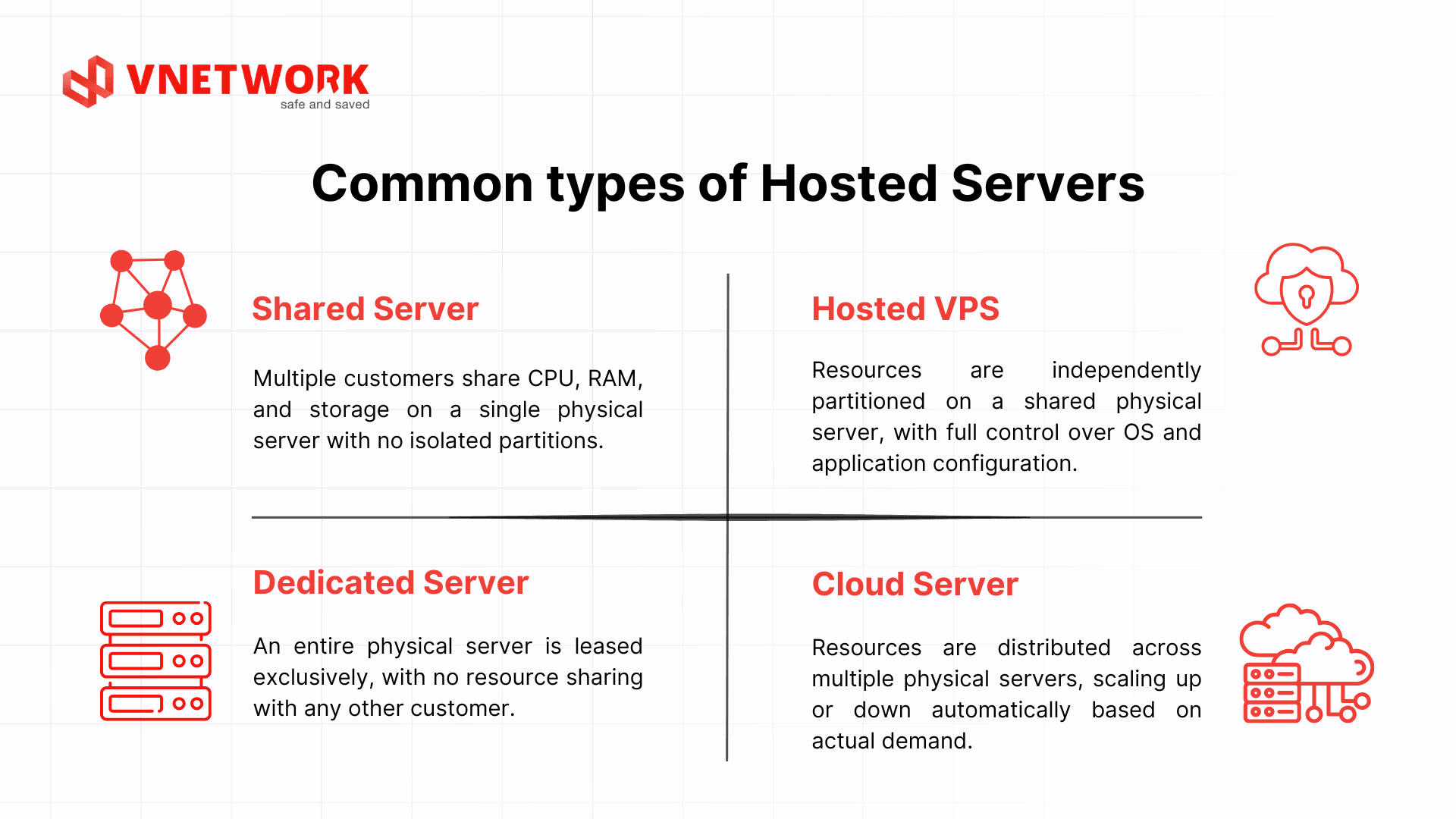
Shared server, or shared hosting, is the most basic form of hosted server. Multiple customers share the same CPU, RAM, and storage on a single physical server with no isolated partitions. The standout advantage is low cost; however, each website's performance depends on the resource consumption of other customers on the same server. Shared servers are best suited for personal websites, blogs, or small businesses just getting started with low traffic and no demanding requirements for security or dedicated performance.
A hosted VPS is a virtual private server running on a shared physical machine, but with CPU, RAM, and storage independently partitioned for each customer. Businesses have full control to configure the operating system and applications within their partition, without being affected by other users on the same physical host. Hosted VPS is the most popular choice in the SME segment thanks to its reasonable pricing, stable performance, and flexible resource scaling as demand grows.
A dedicated server means leasing an entire physical server exclusively, with no resource sharing with any other customer. This is the choice for large enterprises, high-traffic systems, or applications demanding maximum performance and the highest level of security. Bare metal server is a form of dedicated server without a virtualization layer, allowing full utilization of raw hardware power.
A cloud server runs on a cloud computing platform, allowing resources to be automatically scaled up or down based on actual demand. Unlike traditional VPS, cloud servers distribute resources across multiple physical machines, ensuring high availability even if one node fails. Cloud servers are ideal for businesses with traffic that fluctuates heavily across seasons, marketing campaigns, or unexpected events, as costs are based solely on actual resource usage.
Businesses choose hosted servers over on-premise investment for many practical reasons, especially in the context of digital transformation where infrastructure must be flexible and ready to scale quickly.
Using a hosted server does not mean security is fully guaranteed. Servers exposed to the internet are constant targets for various types of attacks, most commonly DDoS attacks, unauthorized access through application vulnerabilities, and data breaches.
DDoS-protected hosting is a feature where the provider integrates traffic filtering and absorption capabilities to block malicious traffic before it reaches the customer's server. Anti DDoS services operate at the infrastructure level, protecting servers from attacks at Layer 7 and lower network layers.
When evaluating the security posture of a hosted server provider, businesses should check the following criteria:
The hosted server market offers many options at varying price points and quality levels. Businesses should evaluate based on practical criteria rather than price alone.
VCLOUD is the cloud computing platform of VNETWORK, built on a strategy of domestic infrastructure self-sufficiency. VCLOUD helps Vietnamese businesses address two simultaneous pressures: rising international cloud costs and the data localization requirements under Law No. 91/2025/QH15. Rather than relying on the global hardware supply chain, VCLOUD maintains stable pricing and continues to upgrade its infrastructure even during the most volatile market periods. Businesses can deploy, operate, and scale their IT systems efficiently without investing in physical infrastructure, while ensuring data is stored and processed in full compliance with current Vietnamese legal requirements.
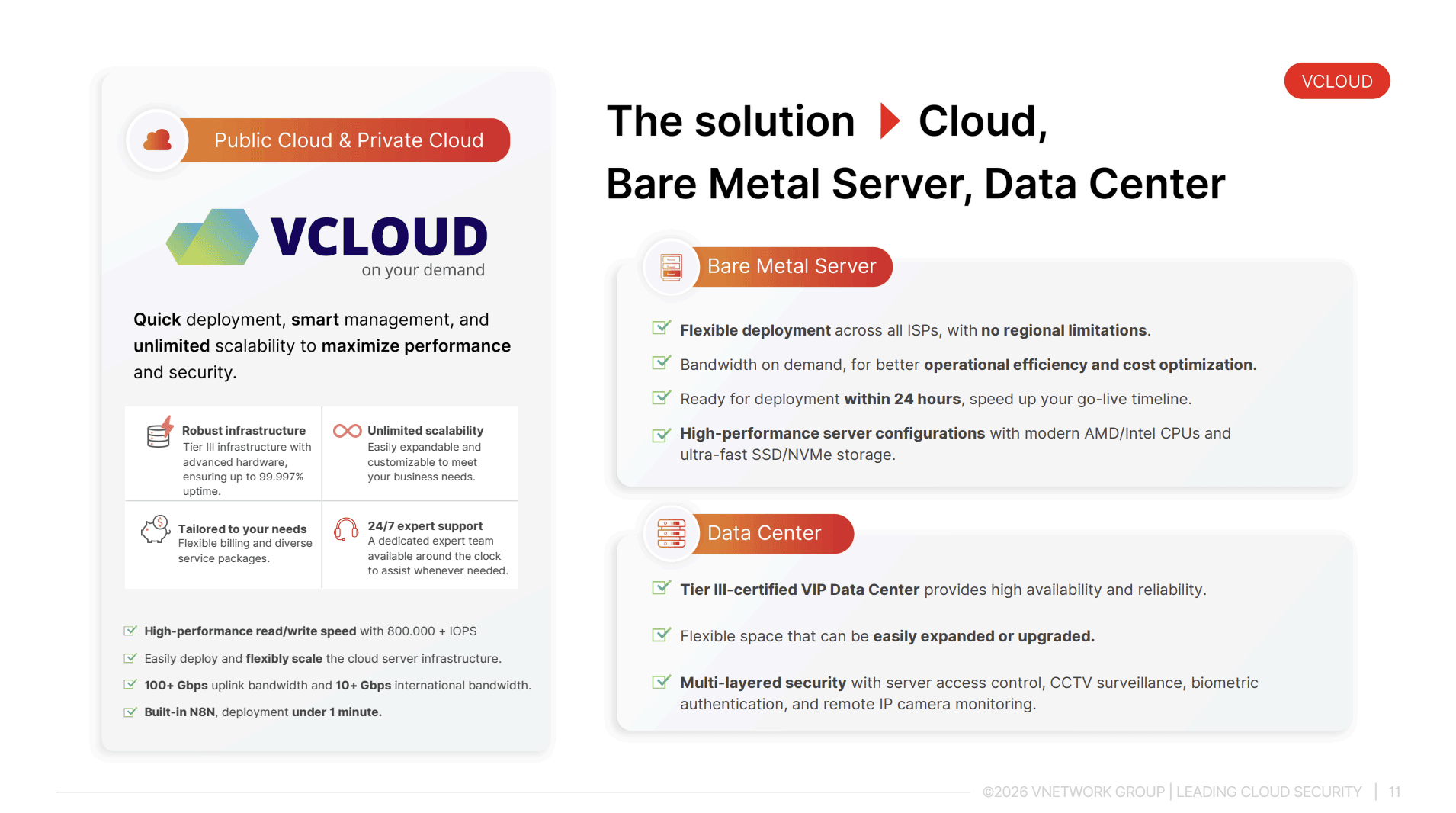
VCLOUD operates on a Tier III-certified data center with cutting-edge hardware, guaranteeing uptime of up to 99.997%. The storage system supports read and write speeds of up to 800,000 IOPS, meeting the demands of large-scale data processing, e-commerce, and AI workloads. Uplink bandwidth reaches 100+ Gbps with international bandwidth of 10+ Gbps, ensuring stable, high-speed connectivity for businesses of all sizes. A dedicated technical team provides 24/7 support, ready to resolve any incident promptly.
VCLOUD integrates Firewall, Security Group, two-factor authentication (2FA), and SSH Key Pair for strict access control. The platform holds ISO 27001 certification, validating its information security management processes against international standards. This makes VCLOUD particularly suitable for businesses in finance, healthcare, and e-commerce with stringent compliance requirements.
VCLOUD allows businesses to increase or decrease CPU, RAM, and cloud storage capacity based on actual load, without any system downtime. This capability is well-suited for e-commerce businesses, AI applications, and Big Data workloads where resource demands shift continuously across different phases.
VCLOUD serves businesses that need stable, cost-effective infrastructure; large enterprises migrating from on-premise to cloud; and organizations that need a flexible platform to deploy AI systems, Big Data pipelines, or high-traffic web applications.
A hosted server is a strategic choice that enables businesses to build flexible, cost-efficient IT infrastructure that is ready to scale without investing in physical hardware. Whether you choose hosting in the form of VPS, dedicated, or cloud server, the decisive factors remain infrastructure quality, security capability, and the provider's reliability. VCLOUD by VNETWORK is a hosted server solution built specifically for the Vietnamese market, combining internationally certified infrastructure, multi-layer security, and 24/7 technical support. Contact VNETWORK to receive tailored advice for your business scale and industry.
Regular hosting (shared hosting) is a setup where multiple websites share the resources of a single server with no isolated partitions. A hosted server encompasses forms such as VPS, dedicated server, or cloud server, where businesses have dedicated resources, full control over operating system configuration, and no interference from other users. Hosted servers are suited to businesses that need higher performance and security than shared hosting can provide.
Yes. A hosted VPS is an ideal choice for small and medium-sized businesses because it costs less than a dedicated server while still providing isolated resources, stable performance, and flexible scaling. Small businesses can start with a basic VPS plan and upgrade as they grow, without needing to change providers or perform complex data migrations.
DDoS-protected hosting is a service that integrates detection and filtering of attack traffic from various DDoS attack types before malicious traffic can affect the server. This feature is essential for most businesses operating online, particularly in e-commerce, finance, and media, where a successful DDoS attack can cause severe service disruption and revenue loss.
Businesses should request documentation from the provider covering security certifications (ISO 27001), data protection policies, and technical measures such as firewall, 2FA, and data encryption both in transit and at rest. Additionally, verify whether the provider has a 24/7 SOC monitoring team and a clearly defined incident response process before signing any contract.
Migration time depends on data volume, application complexity, and the migration plan. For systems that are not overly complex, the process typically completes within a few days to a week. Reputable providers usually offer dedicated migration support teams to help businesses plan a transition with no service interruption.