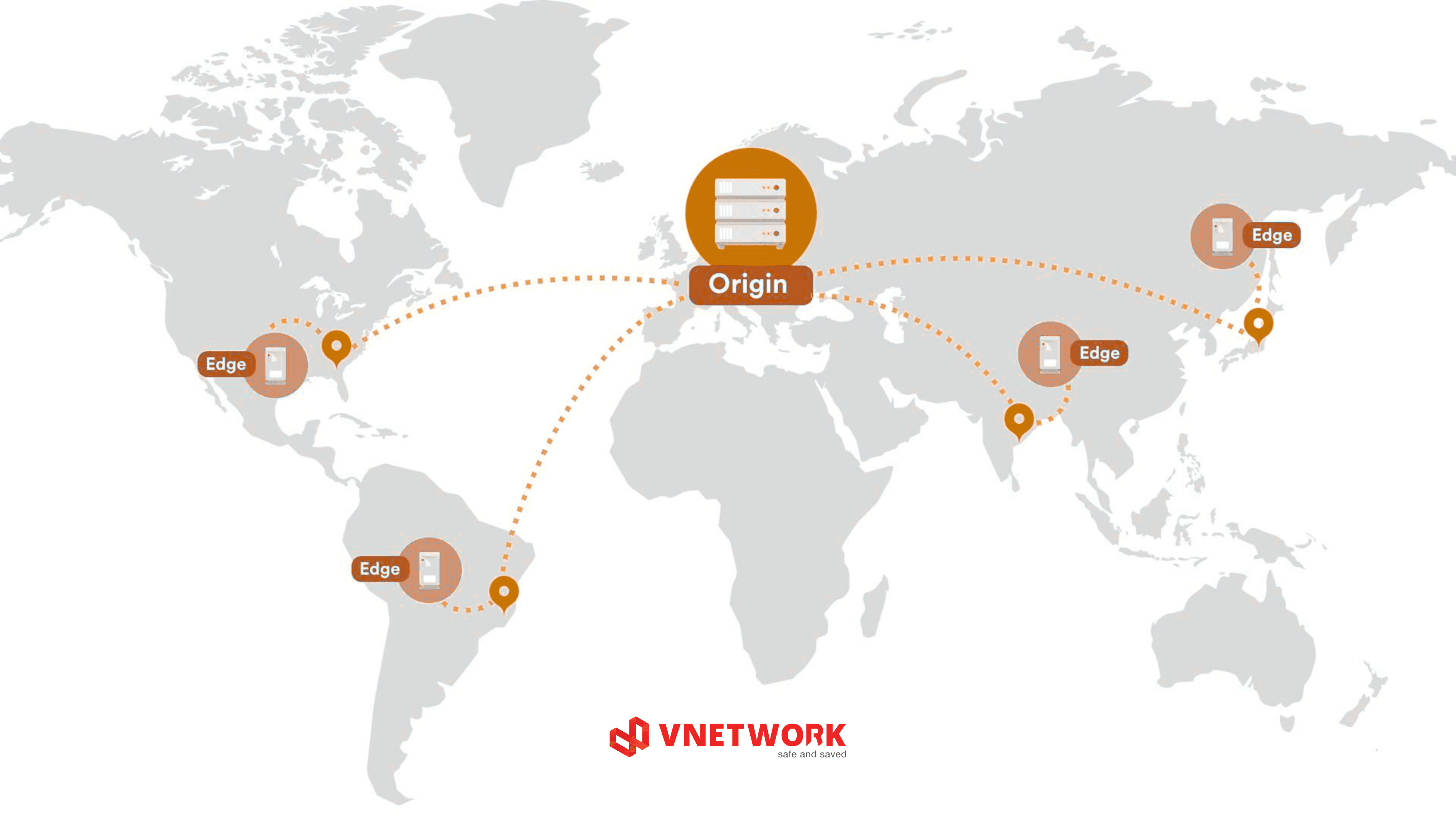
CDN (Content Delivery Network) is a system of multiple servers distributed across different geographic locations around the world, working in coordination to deliver website content to users as quickly and reliably as possible.
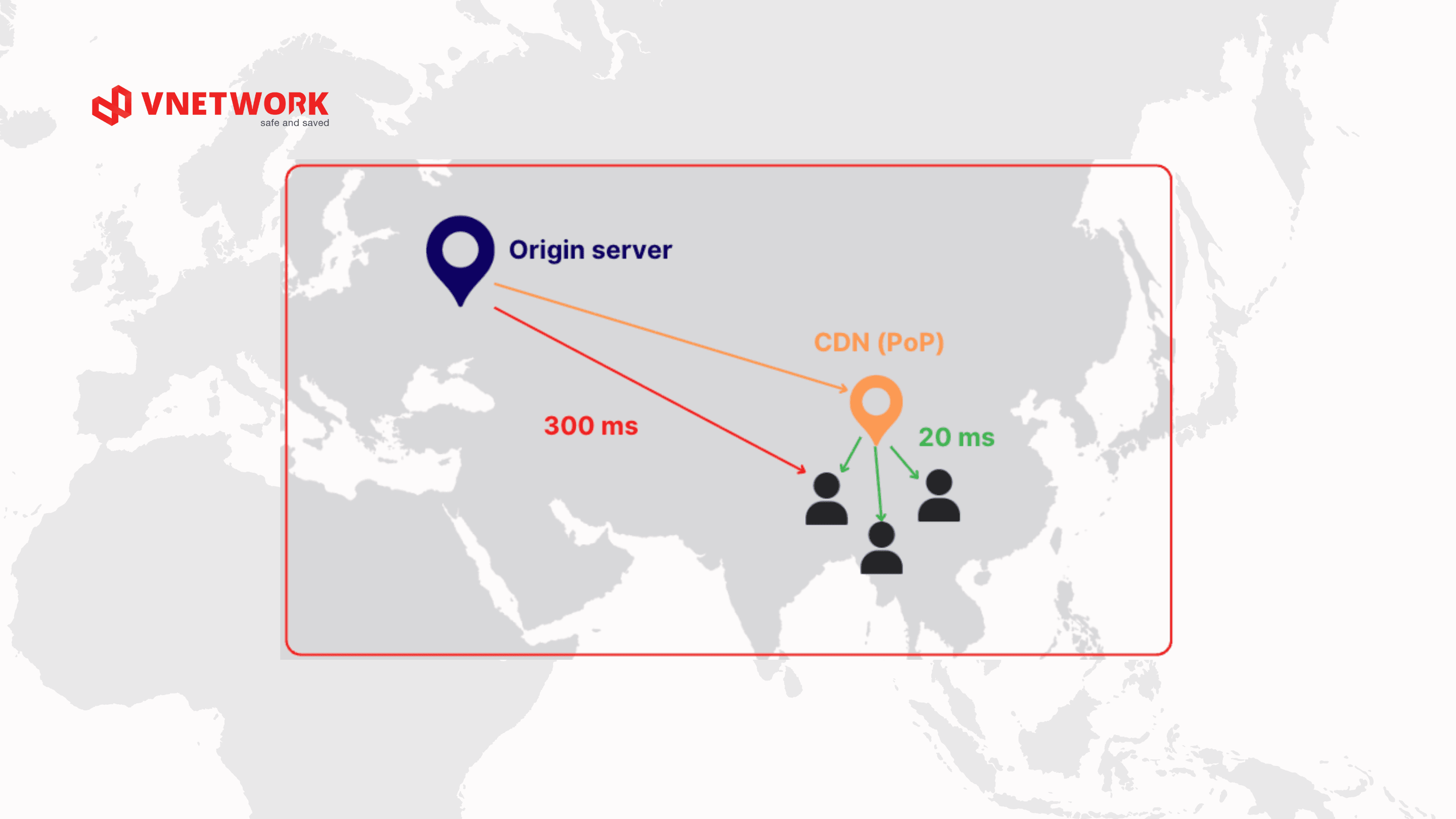
Instead of every access request having to travel all the way back to the origin server (Origin Server) located at a fixed location, a CDN automatically routes users to the nearest edge server (Edge Server) to retrieve content. As a result, page load times are significantly reduced, the load on the origin server decreases substantially, and the overall user experience is greatly improved.
A CDN works closely with the DNS system to route requests to the correct Edge Server. A CDN is also a complementary infrastructure layer for traditional hosting, not a replacement: hosting stores the original data and handles backend logic, while the CDN is responsible for distributing content to end users as quickly as possible.
Commercial content delivery networks emerged in the late 1990s, as the Internet became mainstream and major events caused sudden traffic spikes that took many websites offline. This phenomenon is known as a "flash crowd". CDNs were created to spread the load across many servers, keeping websites accessible even at peak times.
Since then, CDN has evolved through 3 main stages:
A CDN consists of four main components working together: the origin server, edge servers, points of presence (PoPs) and the DNS routing layer. Understanding the role of each component helps businesses evaluate providers and troubleshoot performance issues more accurately.
| Component | Role | Metric to monitor |
|---|---|---|
| Origin server | Stores the original content and serves as the data source when an edge server has no copy yet | Time to first byte (TTFB) |
| Edge server | Also called a CDN server; stores cached copies of content and returns them to users | Cache hit ratio |
| Point of presence (PoP) | A location housing a cluster of edge servers in a data center, usually connected directly to ISPs | Latency to users |
| DNS/GSLB routing layer | Selects the appropriate edge server for each request | DNS resolution time |
Many CDNs also add an intermediate cache tier (origin shield) between the edge servers and the origin server. When multiple edge servers need the same uncached content, this tier consolidates their requests so the origin server is not overwhelmed all at once.
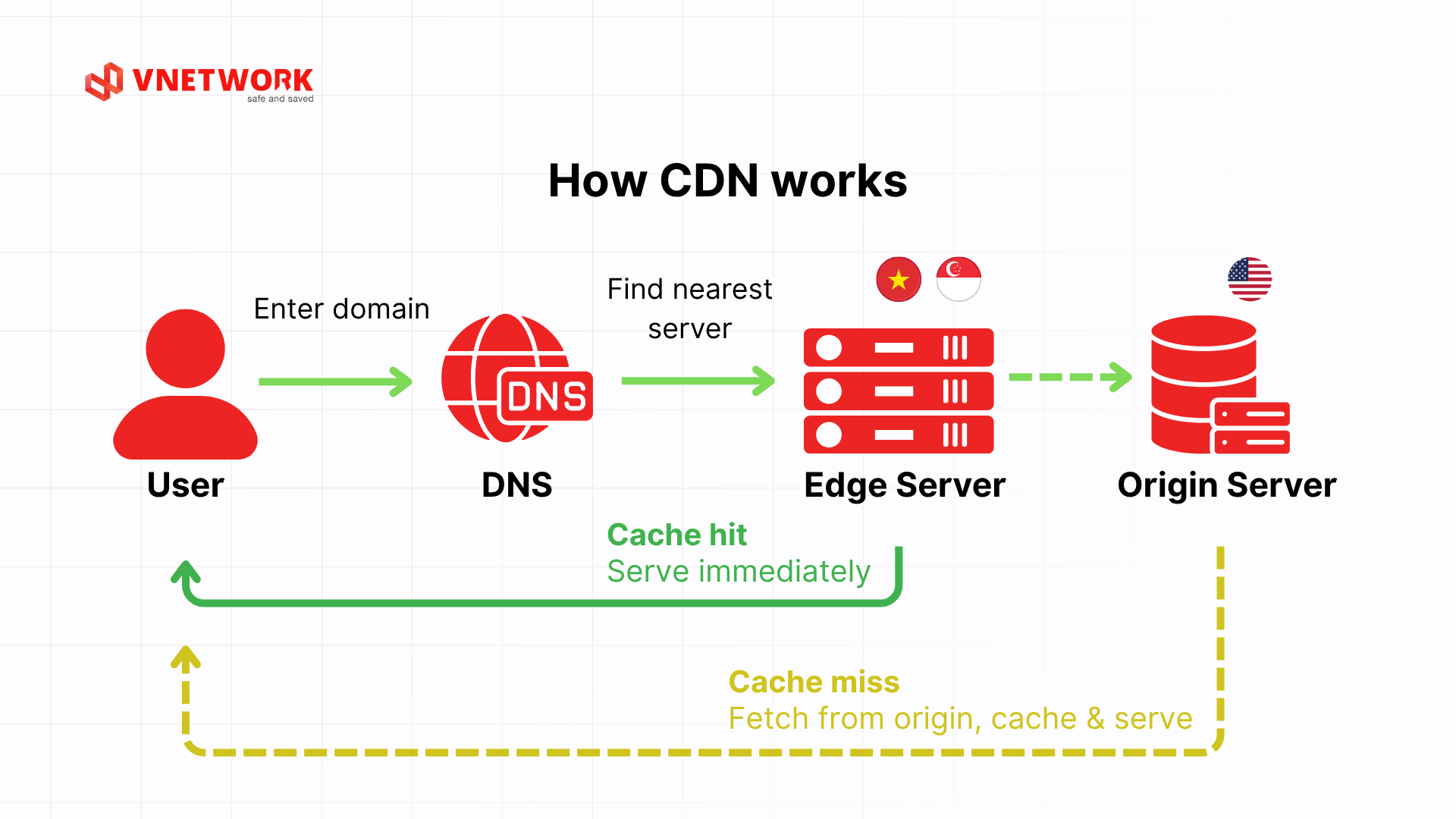
A CDN works by routing user requests to the nearest edge server and returning content from its cache instead of fetching everything from the origin server. To understand how a CDN works, follow the journey of an access request from a user in Vietnam to a website whose origin server is located in the United States.
Without a CDN, every request must travel a long route: from a user's computer in Hanoi, across thousands of kilometres of undersea fibre optic cables, all the way to a server in New York, and then back again. The greater the distance, the higher the latency.
With a CDN, that journey is dramatically shortened through 4 steps:
A simple analogy: imagine a nationwide convenience store chain. Instead of every purchase requiring a trip back to an overseas factory, the local warehouse already has stock ready to deliver on the spot.
Website content falls into two types: static content and dynamic content. A CDN handles each type differently:
CDN cache is a copy of content temporarily stored on an edge server so it can be returned to users without fetching it again from the origin server. How long content stays in the cache is determined by its TTL (Time to Live), usually set through the Cache-Control header from the origin server or through cache rules on the CDN. When the TTL expires, the edge server revalidates the content or fetches a fresh copy from the origin server.
The first time a piece of content is requested in a region, the edge server must fetch it from the origin server, so the response is slower. From then on, the content is served directly from the cache at a higher speed.
A CDN is used to speed up website loading, reduce the load on the origin server, save bandwidth costs and add a layer of protection against attacks. Specifically, a CDN delivers six main groups of benefits for business websites:
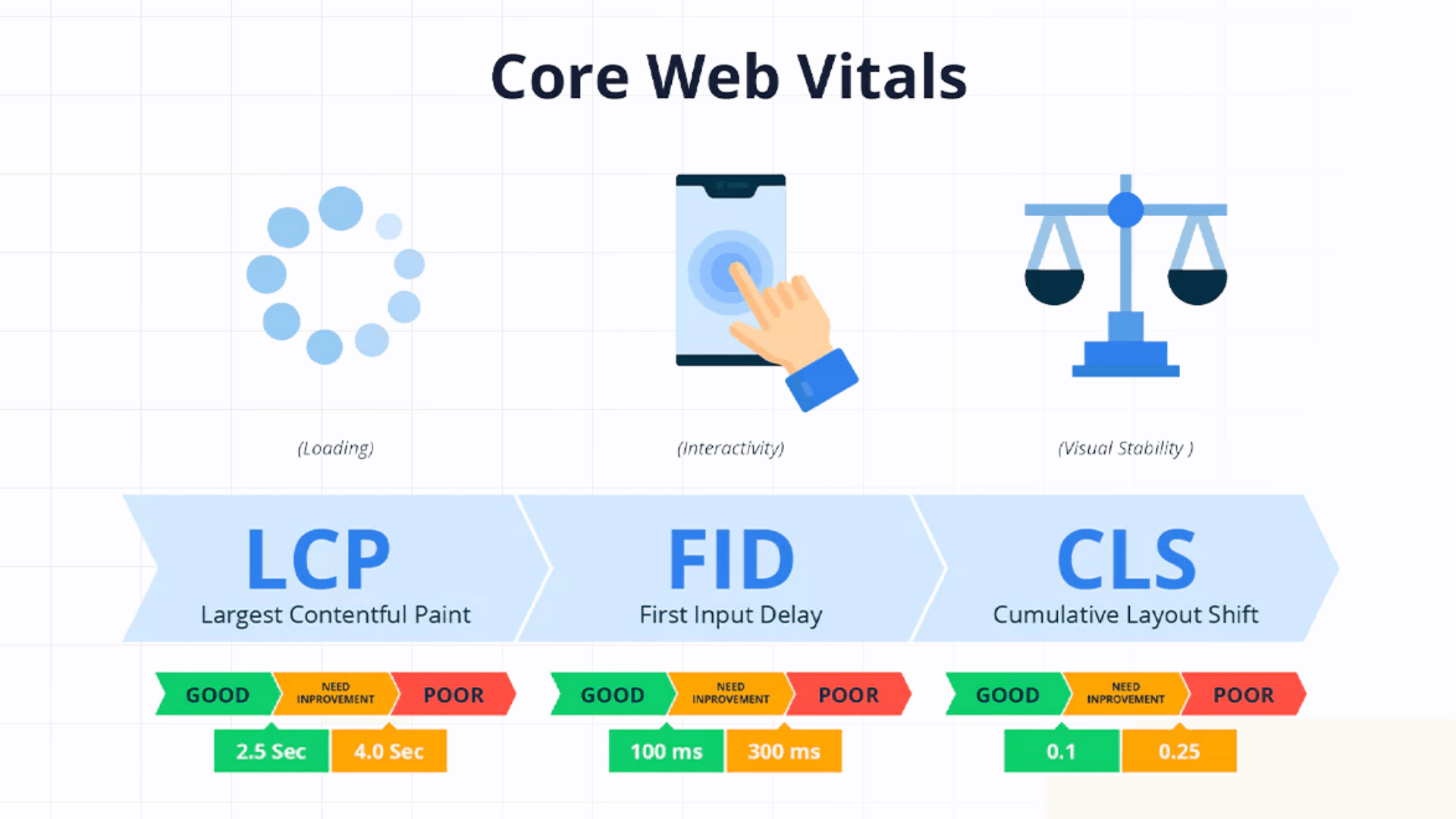
The most visible benefit of a CDN is page load speed. When images, CSS and JavaScript are served from edge servers close to users, waiting time drops significantly, especially for users far from the origin server. This speed also helps improve Core Web Vitals metrics such as LCP (Largest Contentful Paint). For e-commerce websites, fast-loading product pages and banners during sales seasons help reduce the number of shoppers who leave mid-purchase.
Every file served from the cache is a request the origin server does not have to process. For high-traffic websites, edge servers handle most static requests, allowing the origin server to focus its resources on dynamic tasks such as logins, payments and database queries. As a result, the system runs more reliably during traffic spikes.
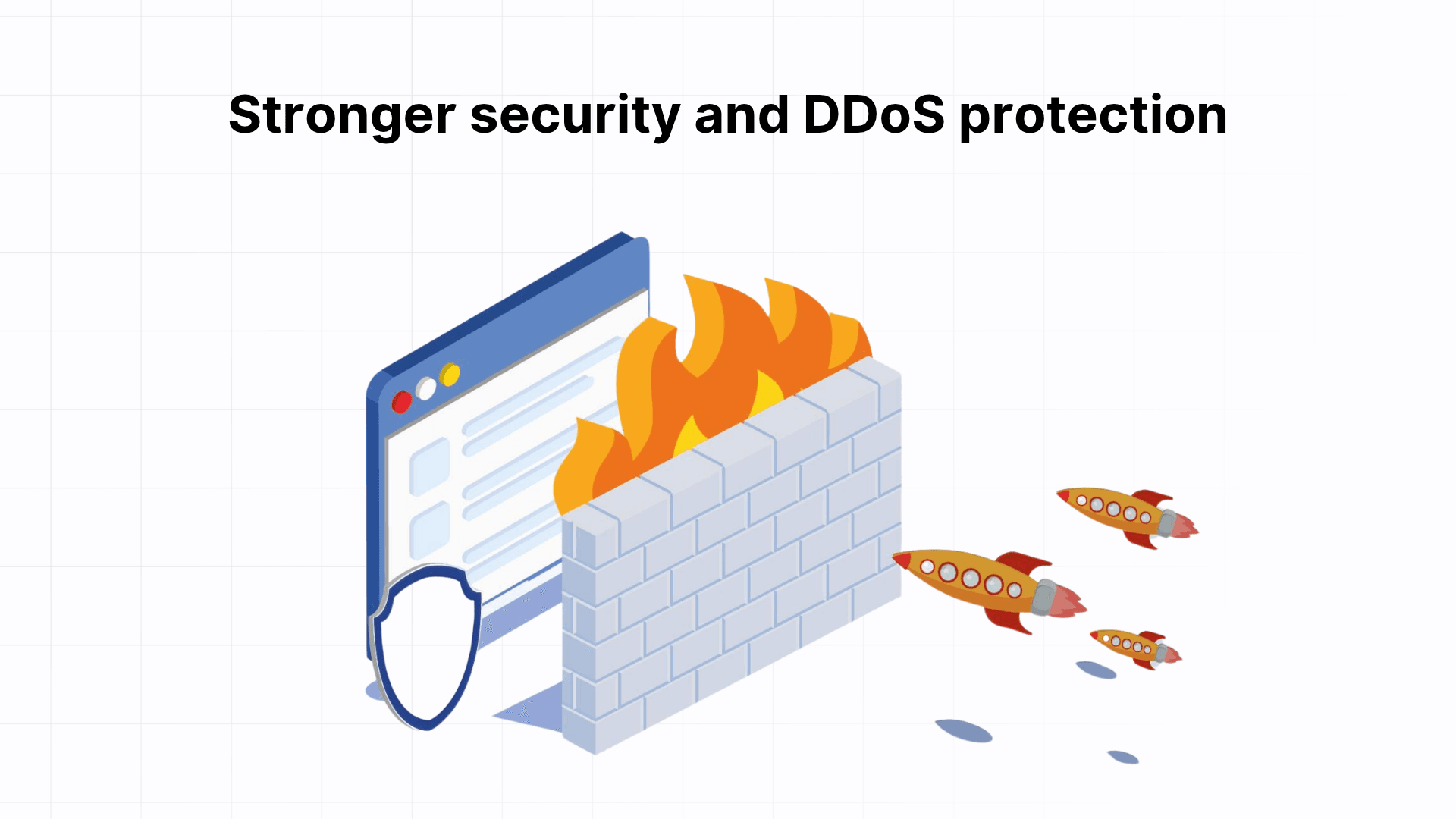
In terms of security, the CDN’s distributed server network helps absorb and disperse DDoS attacks at the network layer (Layer 3/4 of the OSI model), including traffic from botnets, while hiding the real IP address of the origin server. In addition, some CDNs are combined with a web application firewall (WAF), allowing them to block Layer 7 attacks such as SQL injection, XSS and HTTP flood.
CDNs also commonly support SSL/TLS certificates and rate limiting to control abnormal traffic. For systems that need to protect web, applications and APIs, the WAAP model is a natural extension of the security layer on a CDN.
Bandwidth costs fall when most data is served from edge servers instead of the origin server. Businesses also do not need to invest heavily in central infrastructure just to handle a few peak periods each year. This benefit is most evident for online newspapers, video platforms and e-commerce marketplaces, where media traffic makes up a large share.
With PoPs located in many regions, a CDN gives users in Vietnam, Asia and Europe a similar experience when accessing the same website. This is a key factor for businesses expanding into international markets or serving users across borders.
When an edge server fails, the CDN automatically redirects traffic to another edge server (failover), helping to limit downtime without manual intervention. Some CDNs also continue serving cached content when the origin server is temporarily unresponsive. This capability is especially important for finance, banking and payment gateways, where service disruptions directly affect transactions.
A CDN is not a fix for every performance problem. Businesses should understand the following limitations before deployment so they can configure it correctly from the start:
Beyond these practical limitations, some misconceptions about CDNs also lead businesses to choose the wrong solution or delay deployment:
Hosting and CDN solve two different problems: hosting stores and processes the original data, while a CDN optimizes the path content takes to reach users. The table below compares these two infrastructure layers:
| Criteria | Traditional hosting | CDN |
|---|---|---|
| Server location | A single fixed location | Multiple PoPs across many regions |
| Latency | Increases as users get farther from the server | Lower, since content is served from edge servers |
| Scalability | Requires hardware or plan upgrades | Distributes load according to traffic |
| DDoS protection | Limited | Absorbs and disperses network layer attacks |
| Bandwidth costs | Rise sharply during traffic spikes | Lower thanks to caching on edge servers |
| Main role | Stores original data, handles backend processing | Delivers content to users |
CDN types differ in how content moves from the origin server to edge servers and in their operating model. Here are four common models:
| CDN type | How it works | Advantages | Best for |
|---|---|---|---|
| Pull CDN | The CDN fetches content from the origin server on request | Easy to deploy, no manual uploads | Blogs, business websites |
| Push CDN | Administrators push content to the CDN in advance | Tight control over cached content | Large files, software and game distribution |
| P2P CDN | Users act as distribution nodes | Leverages community resources | Decentralized streaming, non-profit organizations |
| Cloud CDN | A CDN built into a cloud platform | Easy to manage, flexible | Businesses already using cloud infrastructure |
A pull CDN suits most business websites because it requires no change to how content is published to the origin server. Many providers also allow pull and push to be combined in a single configuration. For systems that need higher availability, businesses can combine multiple providers in a Multi-CDN model; see Multi-CDN vs single CDN or VNETWORK’s Multi-CDN solution. If you are weighing edge processing against cloud processing, see edge computing vs cloud computing.
A CDN is not a direct ranking factor, but it affects SEO indirectly through page load speed, Core Web Vitals and stability when both users and search bots access the site. Fast, error-free pages improve the user experience and support search engine crawling.
Conversely, a misconfigured CDN can harm SEO:
Therefore, after deploying a CDN, businesses should review crawl reports, indexing status and the website’s Core Web Vitals to adjust the configuration promptly.
Businesses should consider a CDN when their website or application has at least one of the following characteristics:
On the other hand, internal websites, systems that only serve users near the server, or very low-traffic sites may not need a CDN right away. In those cases, optimizing the origin server and images usually delivers results first.

Flash sales and peak shopping seasons drive sharp traffic increases in a short time. A CDN caches product images and banners, reducing the load on the origin server and keeping page speed stable when many shoppers buy at once. For omnichannel retail, GSLB and failover keep content consistent across the website, app and other touchpoints. Learn more about CDN for e-commerce.
Unlike e-commerce, the finance sector places its highest demands on low latency and security. A CDN that combines network layer DDoS protection, a WAF and failover helps banking apps and payment gateways stay stable both at peak hours and under attack. Businesses can add a dedicated DDoS protection service and Cloud WAF to strengthen application layer protection.
For online newspapers, breaking news can draw a surge of traffic within minutes. A CDN helps articles, images and video load quickly, avoiding overload at the most critical moment; see more on CDN for online news. For video content, a CDN supports low-latency HLS delivery to maintain broadcast quality for many concurrent viewers. Businesses can also explore low-latency streaming solutions and this list of video streaming CDN providers.
Online learning platforms need to deliver lecture videos and large course materials to many learners in the same time slot. A CDN reduces latency and stuttering during live classes; see CDN for educational websites for details. For game publishers and mobile app developers, a CDN shortens the time needed to download updates and assets, while in-game latency depends mainly on the game servers. Combining cloud storage for media with a CDN for delivery is an effective way to save bandwidth costs.
Not every CDN provider can meet every need. Businesses can use the following seven criteria to evaluate and choose:
| # | Criteria | What to check |
|---|---|---|
| 1 | PoP coverage and infrastructure | PoP locations and coverage in the regions the business needs (Vietnam, Southeast Asia, global) |
| 2 | DDoS protection and security | Layer 3/4 DDoS protection, WAF integration, SSL/TLS, Rate Limit, Token Access |
| 3 | Features and protocols | HTTP/3, QUIC, dynamic content acceleration, video streaming (HLS, DASH), image optimization |
| 4 | Pricing model | Billing by actual bandwidth used or flat rate, with plans suited to SMEs |
| 5 | SLA and technical support | A clear uptime commitment in the contract, 24/7 support including holidays |
| 6 | API and system integration | APIs for automation, integration with CI/CD pipelines and monitoring systems |
| 7 | Reporting and analytics | Intuitive dashboards with real-time charts for traffic, bandwidth and cache hit ratio |
For audiences based mainly in Vietnam, domestic PoP locations and direct connections to ISPs should be a priority, as they directly affect real-world latency. Businesses can also refer to this list of top CDN providers in 2026 to compare options on the market
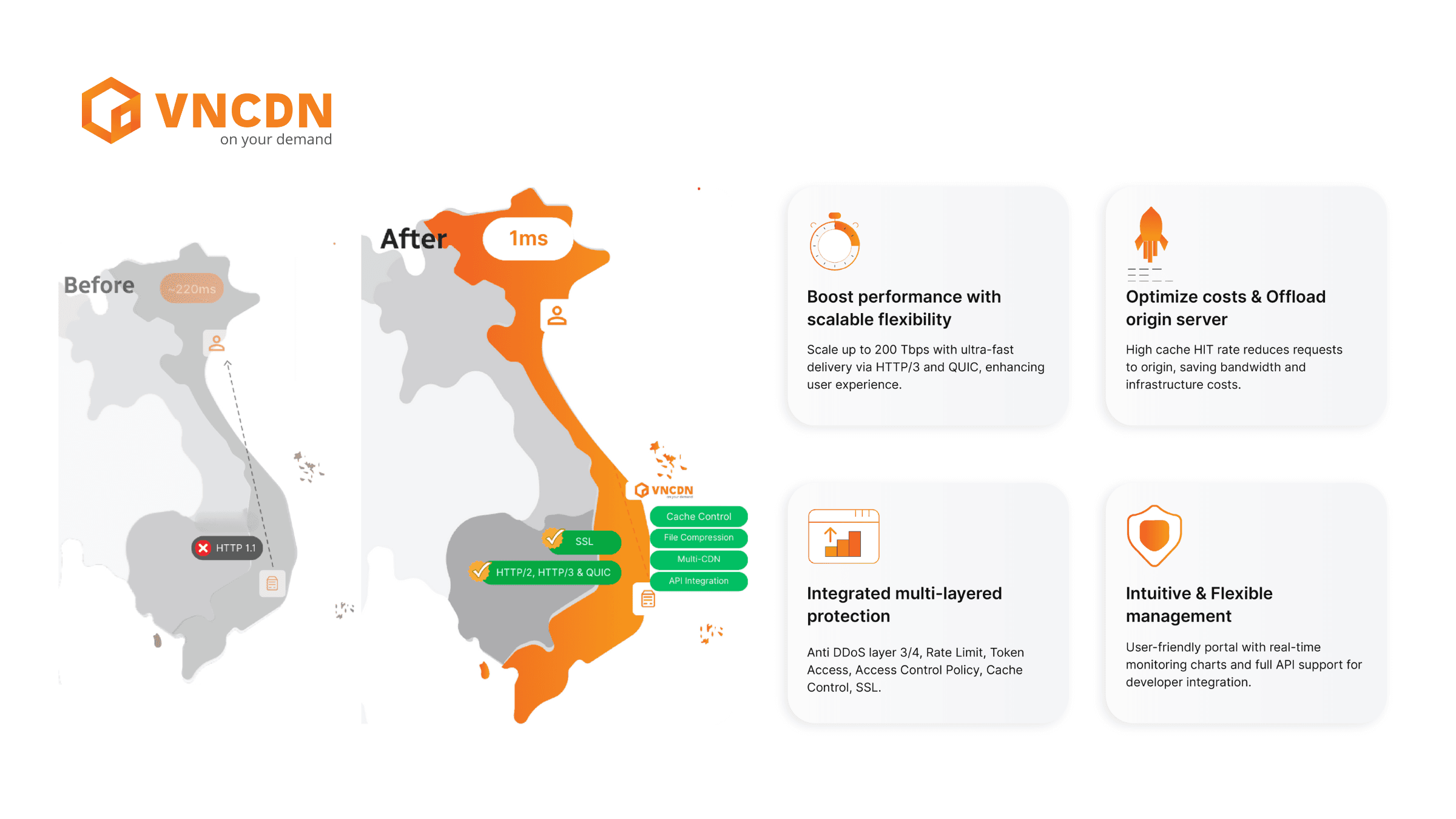
VNCDN is VNETWORK’s CDN service, optimized for users in Vietnam and across Asia. Its PoPs are deployed and directly connected on the infrastructure of Vietnam’s major ISPs, including Viettel, Mobifone, VNPT and others, so content is served from points close to end users, while also connecting to a global PoP network for businesses with international users.
VNETWORK’s infrastructure is trusted by many leading businesses in Vietnam across television, online news, e-commerce and finance, including VTV, FPT Play, Tuoi Tre Newspaper, Tiki, Nguyen Kim and MoMo.
In terms of technical capacity, VNCDN supports up to 10 million concurrent users and 20 billion requests per day, with 15 Tbps of domestic uplink bandwidth. This infrastructure extends globally with more than 2,300 PoPs in 146 countries and 200 Tbps of international bandwidth, serving every scale from e-commerce, media and finance to online education.
Key highlights of VNCDN:
Intuitive & flexible management: easy-to-use portal interface, real-time charts, and API support enabling developers to monitor and optimise performance rapidly.
A live broadcast of the National Day parade leaves no room for error. Even a few seconds of buffering or signal loss would be felt immediately by millions of viewers watching simultaneously across the country.
VNETWORK partnered with VTV for this landmark event, taking full responsibility for the video distribution infrastructure. A high-quality live stream was delivered stably and continuously to every device, from smartphones and laptops to smart TVs, with zero interruptions throughout the entire broadcast.
This stands as the clearest proof of VNETWORK's capacity to operate large-scale video CDN infrastructure when the stakes are highest.

A CDN is an infrastructure layer that makes websites load faster, reduces the load on the origin server and improves resilience against both traffic spikes and DDoS attacks. Understanding what a CDN is, how it works and its limitations helps businesses configure it correctly from the start and avoid mistakes such as misconfigured caching or accidentally blocking search bots. For businesses whose users are mainly in Vietnam, a CDN with PoPs on domestic ISP infrastructure should be a priority. The VNETWORK team provides 24/7 technical support and is ready to advise on the right VNCDN configuration for each system.
Small websites still benefit from a CDN if users access them from many regions or ISPs, the pages contain lots of images and video, or traffic often spikes. Conversely, if a website mainly serves users near the server and traffic is low, the business can optimize the server and images first and consider a CDN later.
It is still worth considering. Hosting the server in Vietnam reduces geographic distance, but users still connect through many different ISPs. When traffic rises, all requests still converge on a single server. A CDN with PoPs on ISP infrastructure helps distribute the load, keep speeds consistent across ISPs and relieve pressure on the origin server at peak times.
CDN pricing is usually based on the volume of data transferred or the bandwidth used, sometimes with charges for the number of requests and add-on features such as security, image optimization or video streaming. Businesses should estimate their monthly traffic and seasonal peaks to choose a suitable plan and avoid unexpected costs.
Not completely. A CDN helps absorb and disperse DDoS attacks at the network layer (Layer 3/4) while hiding the real IP address of the origin server. However, application layer (Layer 7) attacks such as HTTP flood, SQL injection and XSS require a web application firewall (WAF) to detect and block them.
It can, if the cache lifetime (TTL) is set too long for frequently changing content. To avoid this, businesses should set short TTLs for news pages and product prices, version their CSS and JavaScript files, and proactively purge the CDN cache whenever important content is updated.
A CDN delivers content to users from many edge servers located in multiple regions, focusing on reducing latency and offloading the origin server. A load balancer distributes requests across multiple servers within the same system so that no single server is overloaded. The two solutions are often used together.
VNCDN is strong in the Vietnamese market, with PoPs deployed directly on the infrastructure of major domestic ISPs such as Viettel, Mobifone and VNPT, so content is served from the point closest to users. VNETWORK has experience deploying for many leading businesses, including VTV, FPT Play, Tuoi Tre Newspaper, Tiki, Nguyen Kim and MoMo. The system also connects to more than 2,300 PoPs in 146 countries and is backed by a 24/7 NOC team, making it a good fit for businesses with users in Vietnam and across Asia.